• Request Info
  • Visit
  • Apply
  • Give
  • Request More Info
  • Visit
  • Apply
  • Give

Search

  • A-Z Index
  • Map

Geography and Sustainability

  • About
    • Facilities
    • Alumni
    • Research & Community Partners
    • Geographic Links
  • Areas of Study
    • Physical Geography
    • GIST
    • Human Geography
    • Sustainability
  • People
    • Faculty
    • Staff
    • Graduate Students
    • Adjunct & Affliated Faculty
    • Alumni
    • Emeritus
  • Undergraduate
    • Where Can a Geography Degree Take You?
    • Majors
    • Minors
    • Certificates
    • Advising
    • Forms
    • Apply
  • Graduate
    • MS Program
    • PhD Program
    • Apply
    • Graduate Handbook
    • Forms
  • Student Engagement
    • Clubs
    • Community Engagement
    • Awards
    • Internship and Employment
    • Study Abroad
  • News & Events
    • Statements
    • Share Your News
    • Newsletters
    • News
    • Events
    • Geography Awareness Week
    • GeoSym
topography background

News

Human Geography

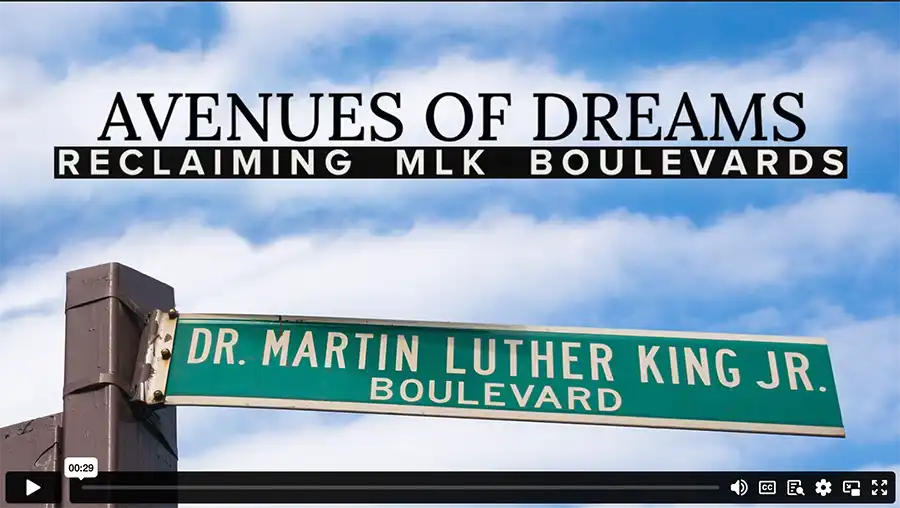
Avenues of Dreams: Reclaiming MLK Boulevards, screen capture

Alderman Featured in Documentary about MLK Streets
February 14, 2022

Alderman Featured in Documentary about MLK Streets

Avenues of Dreams: Reclaiming MLK Boulevards, screen capture

University of Tennessee, Knoxville, Professor of Geography Derek Alderman has spent over two decades researching the hundreds of streets, avenues, and boulevards that have been named after Martin Luther King Jr. and their significance in creating a shared public memory. “The use of place names for commemorative purposes is about creating psychological and emotional connections,” he said in a 2014 story in UT’s Quest magazine.
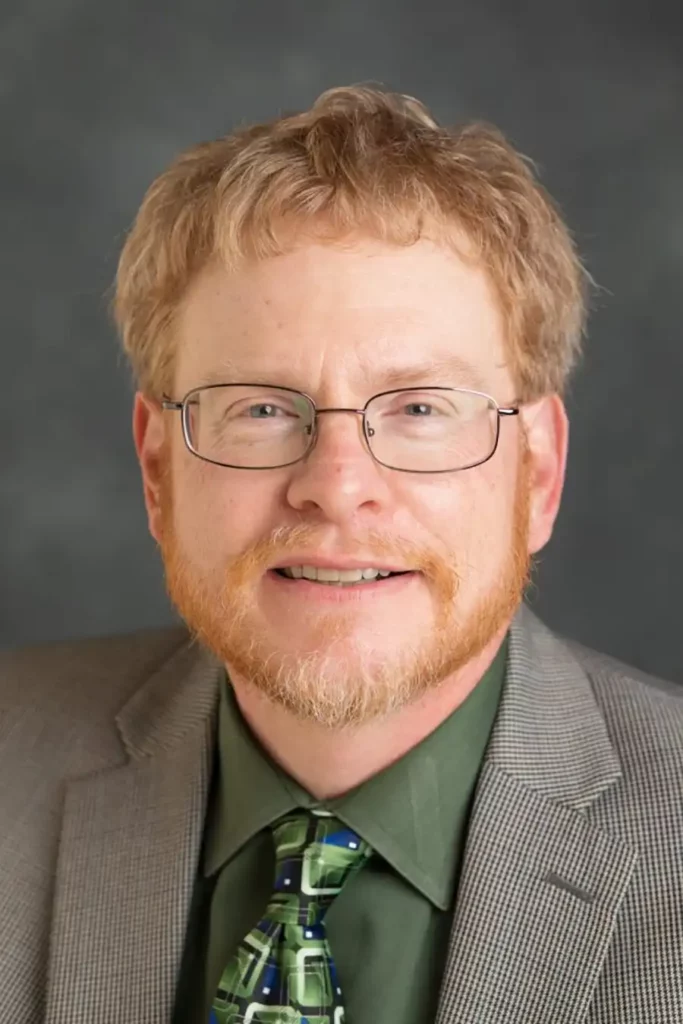
Derek Alderman
Dr. Alderman

Two years ago, when film producers Amber Payne and Rayner Ramirez were planning a documentary about MLK streets, they reached out to Alderman, who suggested case studies and themes to help them develop their narrative. In October 2021, Alderman met with Payne and Ramirez in Baltimore and shared some of his thoughts about MLK streets on camera.

In Avenues of Dreams: Reclaiming MLK Boulevards, now showing on Xfinity’s Black Experience Channel, Alderman appears three times. In the opening minutes, he notes that street names are more than memorials to the past. “They are memorials for effecting social change,” he says, and are increasingly centers of Black activism and resilience. 

Later in the documentary, Alderman comments on the history of redlining, the longstanding policies of banks and the federal government to withhold mortgage loans from areas occupied largely by African Americans. “These policies suggested that the areas were not worthy of improvement and investment,” he says. “The stigmatizing of streets named for Dr. King is reflective of a legacy absolutely found in redlining.”

Near the end of the film, Alderman describes MLK streets as a litmus test for where the country is going and whether it is coming to terms with economic inequalities and systemic racism. Underlying King’s asphalt memorials, according to him, is a broader consideration of “whether the nation is being accountable to Black America or turning its back on Black America.”

Alderman watched Avenues of Dreams for the first time on January 25. “The producers were very generous to include me,” he said. “But I’m especially pleased that the film foregrounds and centers Black residents, community organizers, and development experts working to reclaim and restore MLK Boulevards, giving them the spotlight and amplifying their voices. It’s a chance for us to hear the people in those communities tell their stories in their own words.   

“As a geographer, I am so pleased with the way Amber and Rayner framed the question of where we find these streets. They move beyond just seeing MLK Avenues as locational markers or memorials and situate these streets within the histories, development needs, and civil rights struggles of surrounding neighborhoods. Although the focus of the documentary is on Baltimore and St. Louis, the directors’ emphasis on place-based Black storytelling can help us understand the significance of many of the country’s MLK roadways.”

–Story by Brooks Clark
Filed Under: Department News, Human Geography

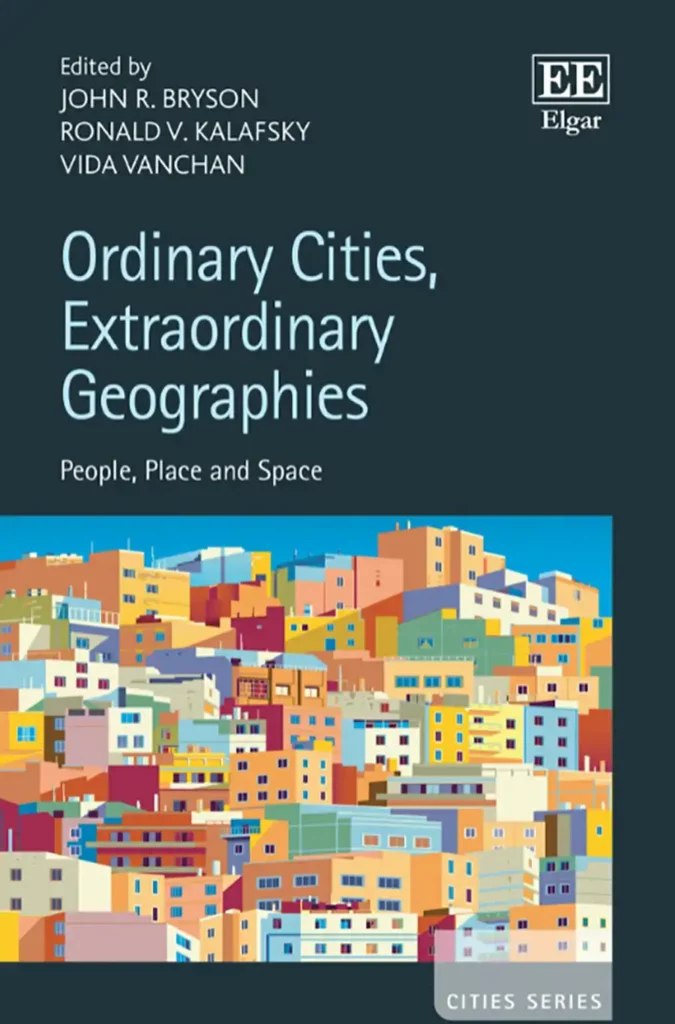
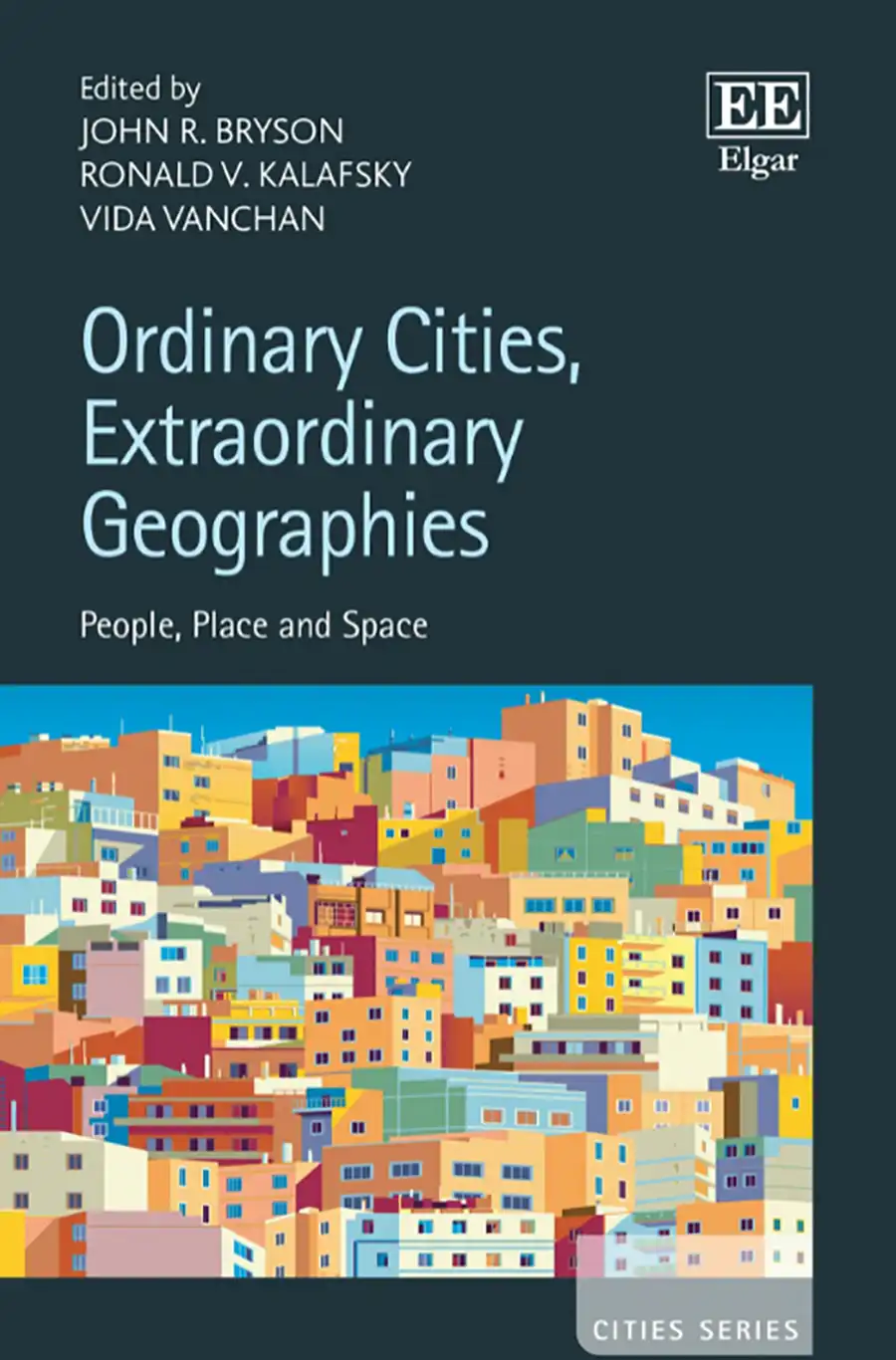
Ordinary Cities, Extraordinary Geographies book cover

Professor Kalafsky published a new book: Ordinary Cities, Extraordinary Geographies

August 16, 2021

Professor Kalafsky published a new book: Ordinary Cities, Extraordinary Geographies

Ordinary Cities, Extraordinary Geographies book cover

Professor Ron Kalafsky just published a new book titled “Ordinary Cities, Extraordinary Geographies“. It is co-edited by Drs. John Bryson and Vida Vanchan.

This insightful book explores smaller towns and cities, places in which the majority of people live, highlighting that these more ordinary places have extraordinary geographies. It focuses on the development of an alternative approach to urban studies and theory that foregrounds smaller cities and towns rather than much larger cities and conurbations.

Here is the link to the book on Google Books: https://books.google.com/books?id=SXg8EAAAQBAJ&lpg=PP1&pg=PP1#v=onepage&q&f=false

Filed Under: Department News, Human Geography

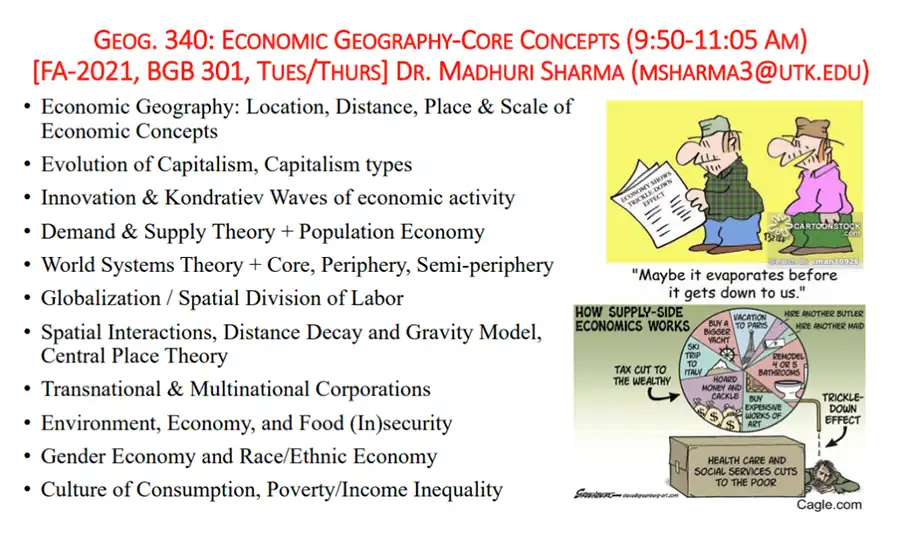
Course flyer for GEOG 340

Course flyers – Geog 340 & Geog 442

August 2, 2021

Dear Students,

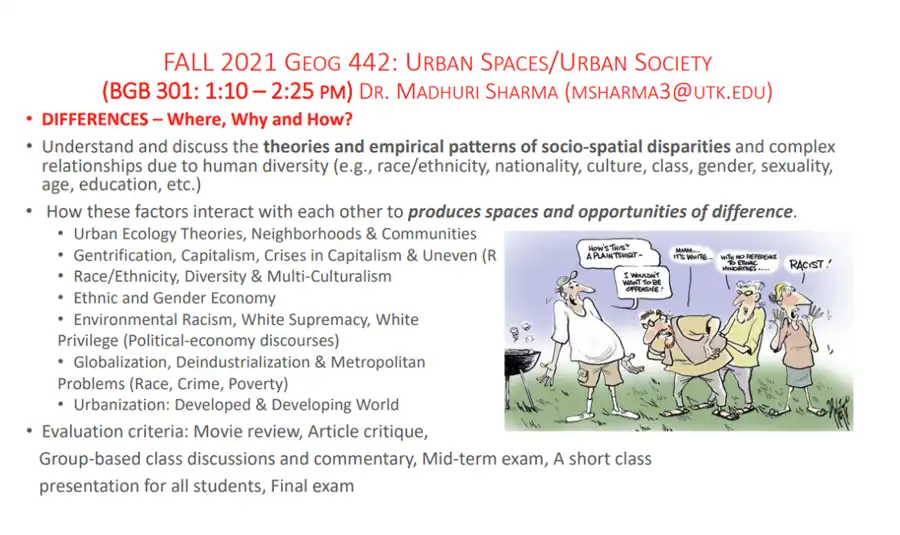
Prof. Madhuri Sharma is offering two courses this Fall 2021 that may be of interest to you in terms of contents as well as in terms of fulfilling several required majors, etc. for you. Please see the flyers in this pdf. Note that GEOG 340 is for UG but 442 can be taken by grads and undergrads both. Feel free to email Dr. Sharma if you have any questions.

GEOG 340 flyer

GEOG 340

Economic Geography-Core Concepts

  • Economic geography: location, distance, place & scale of economic concepts
  • Evolution of capitalism, capitalism types
  • Innovation & Kondratiev Waves of economic activity
  • Demand & Supply theory + population economy
  • World Systems Theory + core, periphery, semi-periphery
  • Globalization / spatial division of labor
  • Spatial interactions, distance decay and gravity model, Central Place Theory
  • Transnational & multinational corporations
  • Environment, economy, and food (in)security
  • Gender economy and race/ethnic economy
  • Culture of consumption, poverty/income inequality
GEOG 442 flyer

GEOG 442

Urban Spaces/Urban Society

  • Differences—Where, Why, and How?
  • Understand and discuss the theories and empirical patterns of socio-spatial disparities and complex relationships due to human diversity
  • How these factors interact with each other to produce spaces and opportunities of difference
    • Urban ecology theories, neighborhoods & communities
    • Gentrification, capitalism, crises in capitalism & uneven
    • Race/ethnicity, diversity & multi-culturalism
    • Ethnic and gender economy
    • Environmental racism, white supremacy, white privilege (political-economy discourses)
    • Globalization, deindustrialization & metropolitan problems (race, crime, poverty)
    • Urbanization: developed & developing world
  • Evaluation criteria: movie review, article critique, group-based class discussions and commentary, mid-term exam, short class presentation for all students, final exam

Filed Under: Course Flyer, Department News, Human Geography

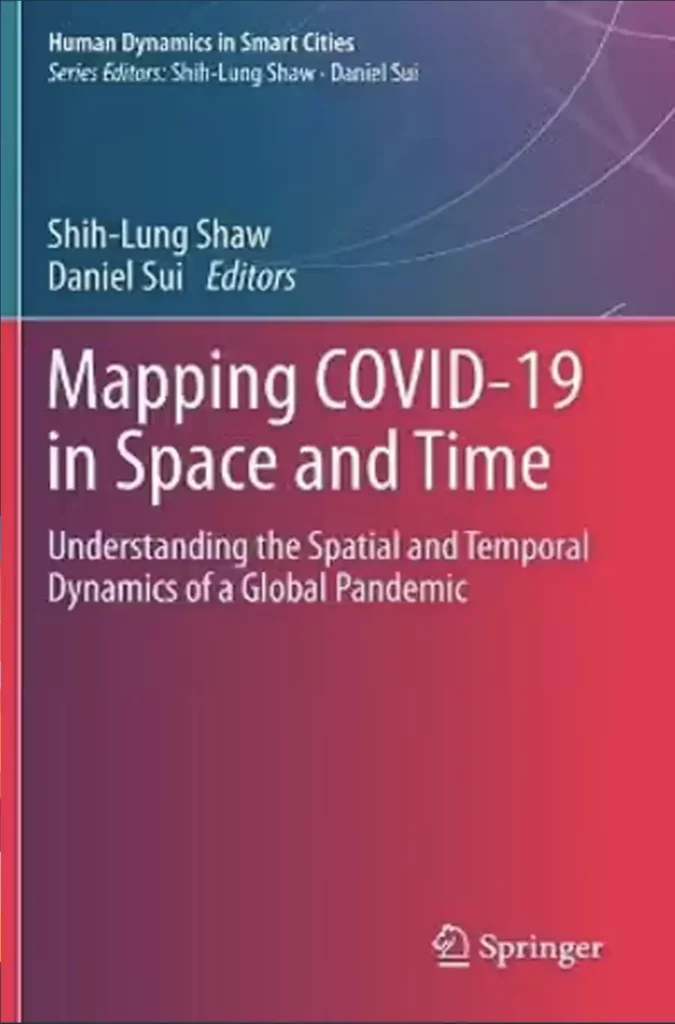
Mapping COVID-19 in Space and Time book cover

Professor Shaw published a new book: Mapping COVID-19 in Space and Time

July 16, 2021

Professor Shaw published a new book: Mapping COVID-19 in Space and Time

Book jacket for Mapping COVID-19 in Space and Time

Professor Shih-Lung Shaw just published a new book titled “Mapping COVID-19 in Space and Time: Understanding the Spatial and Temporal Dynamics of a Global Pandemic”. It is co-edited by Dr. Daniel Sui.

Here is the link to the eBook: https://link.springer.com/book/10.1007%2F978-3-030-72808-3. The print version of the book https://www.springer.com/gp/book/9783030728076 will be available in about 2-3 weeks. Please feel free to contact Professor Shaw if you have any questions about this book. 

About this book:

This book describes the spatial and temporal perspectives on COVID-19 and its impacts and deepens our understanding of human dynamics during and after the global pandemic. It critically examines the role smart city technologies play in shaping our lives in the years to come. The book covers a wide-range of issues related to conceptual, theoretical and data issues, analysis and modeling, and applications and policy implications such as socio-ecological perspectives, geospatial data ethics, mobility and migration during COVID-19, population health resilience and much more.

With accelerated pace of technological advances and growing divide on political and policy options, a better understanding of disruptive global events such as COVID-19 with spatial and temporal perspectives is an imperative and will make the ultimate difference in public health and economic decision making. Through in-depth analyses of concepts, data, methods, and policies, this book stimulates future studies on global pandemics and their impacts on society at different levels.

Filed Under: Department News, GIST, Human Geography

Headshot photo

Professor Ellis received UTK ISSE Grant

July 16, 2021

Professor Ellis received UTK ISSE Grant

Kelsey Ellis headshot photo

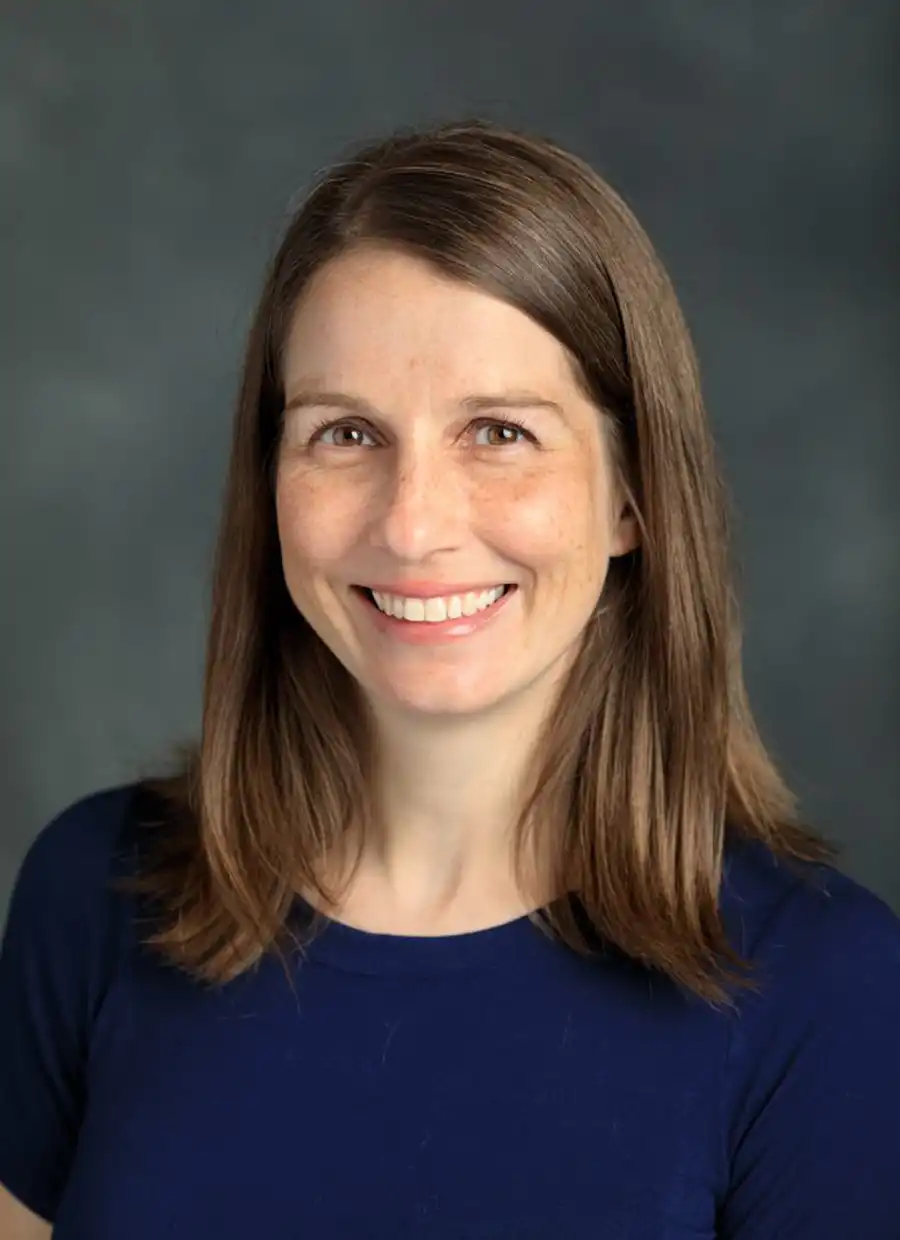
Professor Kelsey Ellis just received a grant from the UTK Institute for a Secure & Sustainable Environment (ISSE). Her project is titled “Beat the heat: Building adaptive capacity of vulnerable populations in Knox County to combined stressors from climate change and urban heat“. Her collaborators on the project include Jennifer First (Social Work) and Kristing Kintziger (Public Health). 

Filed Under: Department News, Human Geography

Headshot photo

Professor Shih-Lung Shaw elected President of UCGIS

June 18, 2021

Professor Shih-Lung Shaw elected President of UCGIS

Dr. Shih-Lung Shaw

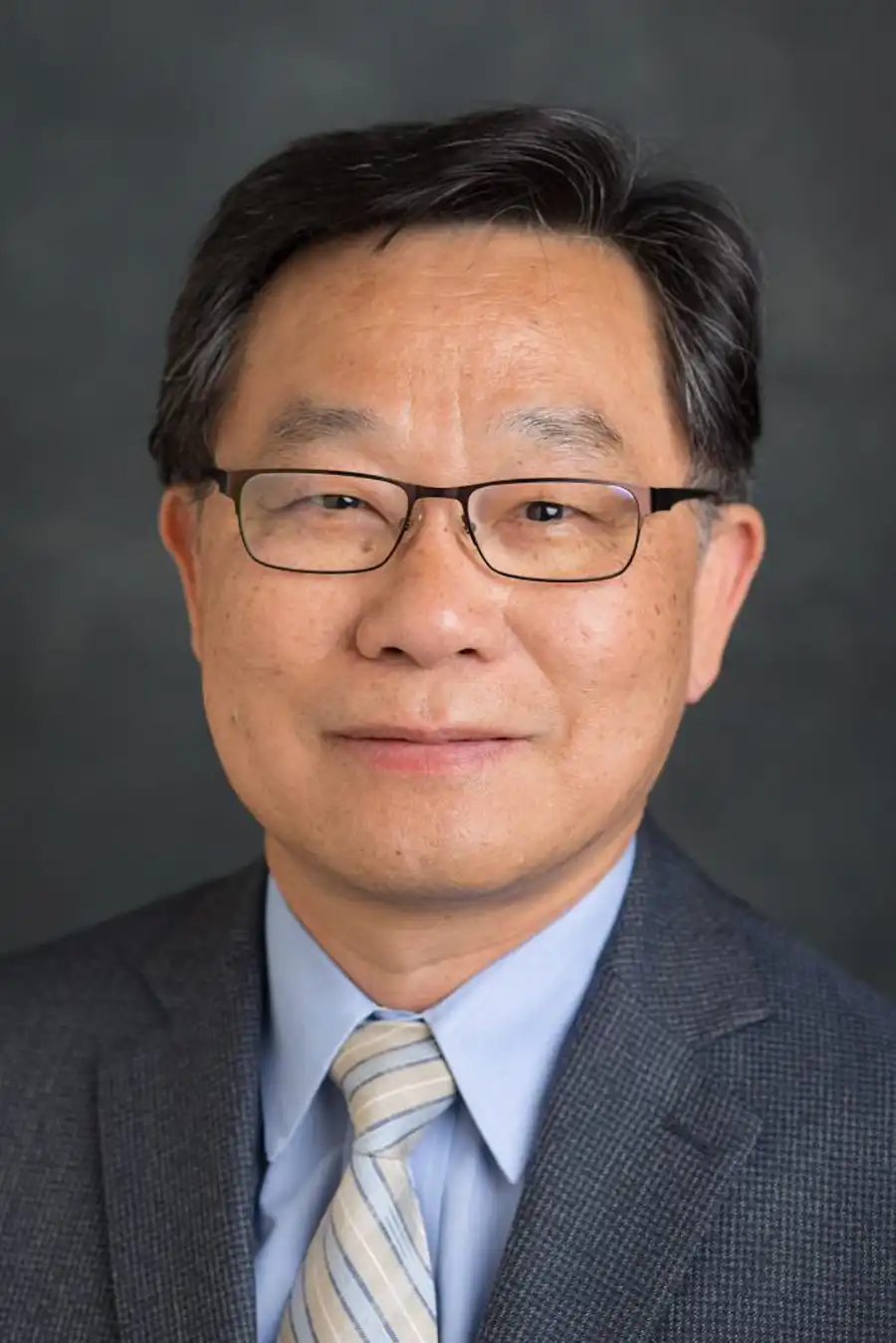
UTK Geography Professor Dr. Shih-Lung Shaw has been elected President-Elect of the University Consortium for Geographic Information Science (UCGIS), which is a non-profit organization that creates and supports communities of practice for GIScience research, education, and policy endeavors in higher education and with allied institutions. It is the professional hub for the academic GIS community in the United States, with partnerships extending this capacity abroad. 

It will be a three-year service and Dr. Shaw will serve as President-Elect, President, and Past President of UCGIS. We thank Dr. Shaw for his service and leadership in GIS. Congratulations!

Filed Under: Department News, GIST, Human Geography

An image of a map of the US entitled "Lynchings of Last Ten Years 1909-1918"

How Black cartographers put racism on the map of America

February 23, 2021

How Black cartographers put racism on the map of America

Derek H. Alderman, University of Tennessee and Joshua F.J. Inwood, Penn State

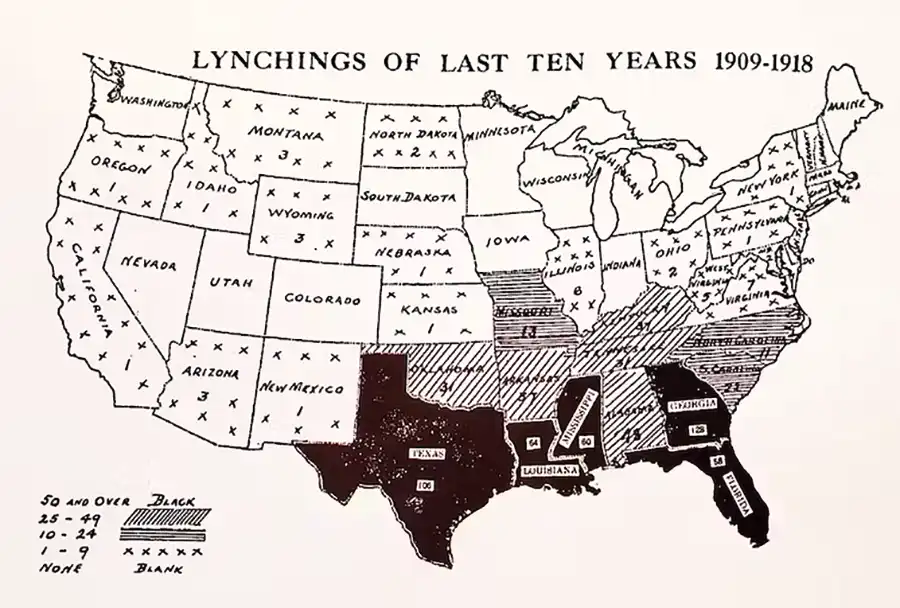
An image of a map of the US entitled "Lynchings of Last Ten Years 1909-1918"
An early 20th-century NAACP map showing lynchings between 1909 and 1918. The maps were sent to politicians and newspapers in an effort to spur legislation protecting Black Americans. Library of Congress

How can maps fight racism and inequality?

The work of the Black Panther Party, a 1960s- and 1970s-era Black political group featured in a new movie and a documentary, helps illustrate how cartography – the practice of making and using maps – can illuminate injustice.

As these films show, the Black Panthers focused on African American empowerment and community survival, running a diverse array of programming that ranged from free school breakfasts to armed self-defense.

Cartography is a less documented aspect of the Panthers’ activism, but the group used maps to reimagine the cities where African Americans lived and struggled.

In 1971 the Panthers collected 15,000 signatures on a petition to create new police districts in Berkeley, California – districts that would be governed by local citizen commissions and require officers to live in the neighborhoods they served. The proposal made it onto the ballot but was defeated.

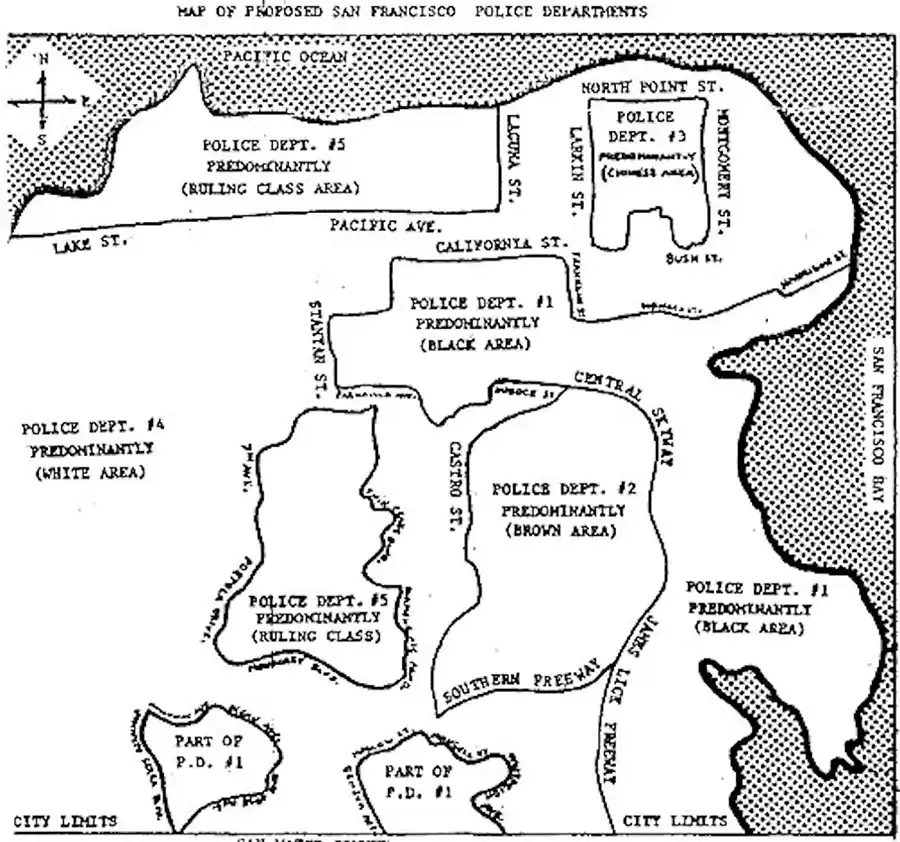
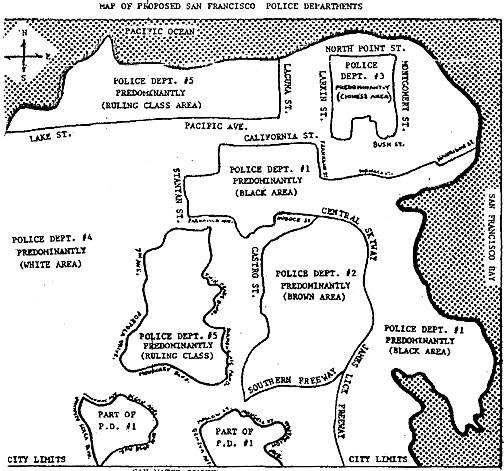
In a similar effort to make law enforcement more responsive to communities of color, the Panthers in the late 1960s also created a map proposing to divide up police districts within San Francisco, largely along racial lines.

A map illustrating inequality in police districting in San Francisco in the 1960s.
The Black Panthers’ proposed police districts for the city of San Francisco, created in 1966 or 1967. Ccarolson/FoundSF, CC BY-SA

The Black Panthers are just one chapter in a long history of “counter-mapping” by African Americans, which our research in geography explores. Counter-mapping refers to how groups normally excluded from political decision-making deploy maps and other geographic data to communicate complex information about inequality in an easy-to-understand visual format.

The Power of Maps

Maps are not ideologically neutral location guides. Mapmakers choose what to include and exclude, and how to display information to users.

These decisions can have far-reaching consequences. When the Home Owners Loan Corporation in the 1930s set out to map the risk associated for banks loaning money to individuals for homes in different neighborhoods, for example, they rated minority neighborhoods as high risk and color-coded them as red.

The result, known as “redlining,” contributed to housing discrimination for three decades, until federal law banned such maps in 1968. Redlining’s legacy is still evident in many American cities’ patterns of segregation.

Colonial explorers charting their journeys and city planners and developers pursuing urban renewal, too, have used cartography to represent the world in ways that further their own priorities. Often, the resulting maps exclude, misrepresent or harm minority groups. Academics and government officials do this, too.

Counter-maps produce an alternative public understanding of the facts by highlighting the experiences of oppressed people.

Black people aren’t the only marginalized group to do this. Indigenous communities, women, refugees and LGBTQ communities have also redrawn maps to account for their existence and rights.

But Black Americans were among the earliest purveyors of counter-mapping, deploying this alternative cartography to serve a variety of needs a century ago.

Black Counter-Mapping

Mapping is part of the broader Black creative tradition and political struggle.

Over the centuries, African Americans developed “way-finding” aids, including a Jim Crow-era travel guide, to help them navigate a racially hostile landscape and created visual works that affirmed the value of Black life.

The Black sociologist and civil rights leader W.E.B. Du Bois produced maps for the 1900 Paris Exposition to inform international society about the gains African Americans had made in income, education and land ownership since slavery and in face of continuing racism.

Similarly, in 1946, Friendship Press cartographer and illustrator Louise Jefferson published a pictorial map celebrating the contributions of African Americans – from famous writers and athletes to unnamed Black workers – in building the United States.

In the early 20th century, anti-lynching crusaders at the NAACP and Tuskegee Institute stirred public outcry by producing statistical reports that informed original hand-drawn maps showing the location and frequency of African Americans murdered by white lynch mobs.

One map, published in 1922 in the NAACP’s magazine “Crisis,” placed dots on a standard map to document 3,456 lynchings over 32 years. The Southeast had the largest concentration. But the “blots of shame,” as mapmaker Madeline Allison called them, spanned the country from east to west and well into the north.

These visualizations, along with the underlying data, were sent to allied organizations like the citizen-led Commission on Interracial Cooperation, to newspapers nationwide and to elected officials of all parties and regions. The activists hoped to spur Congress to pass federal anti-lynching legislation – something that remains to this day unfinished business.

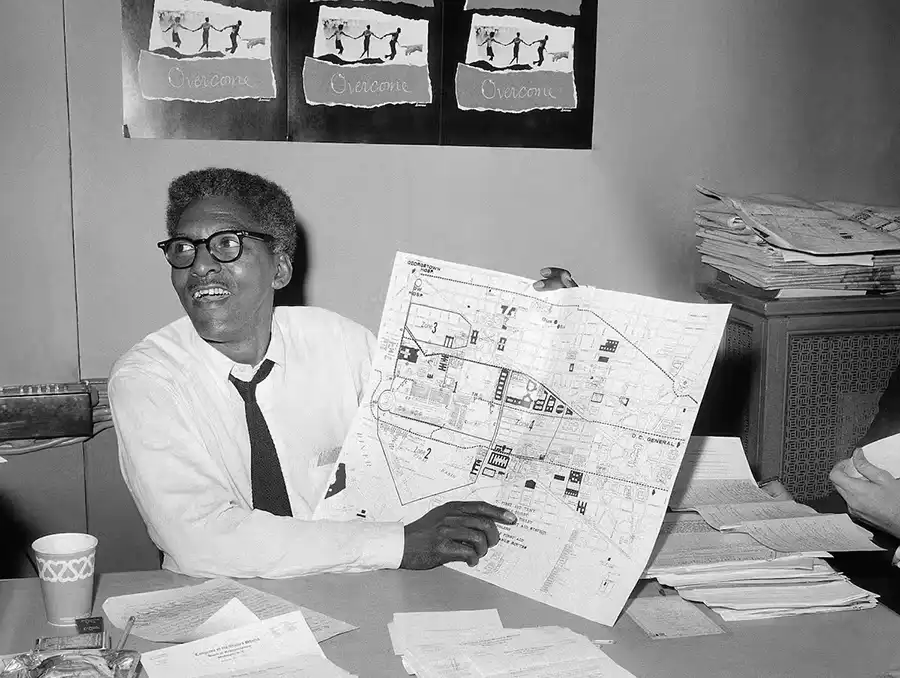
Civil rights activist Bayard Rustin
Civil rights activist Bayard Rustin organizing the 1963 March on Washington, an example of how existing maps can also be used in politically disruptive ways. AP Photo

Much anti-lynching cartography was inspired by the famed activist and reporter Ida B. Wells, who in the early 1880s made some of the first tabulations of the prevalence and geographic distribution of racial terror. Her work refuted prevailing white claims that lynched Black men had sexually assaulted white women.

Modern Maps

The precariousness of Black life – and the exclusion of Black stories from American history – remains an unresolved issue today.

Working alone and with white allies, Black activists and scholars continue using cartography to tell a fuller story about the United States, to challenge racial segregation and to combat violence.

Today, the maps they create are often digital.

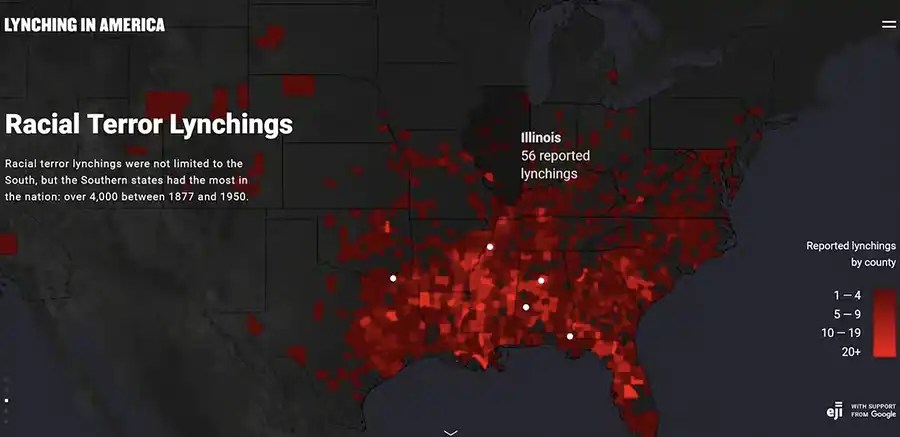
For example, the Equal Justice Initiative, the Alabama-based legal defense group run by Bryan Stevenson, has produced a modern map of historical lynching. It’s an interactive update of the anti-lynching cartography made 100 years ago – although a full reconstruction of lynching terror remains impossible because of incomplete data and the veil of silence that persists around these murders.

A map entitled "Racial Terror Lynchings" depicting lynchings in America between 1877 and 1950.
The Equal Justice Initiative’s map tells stories of people who were lynched. Screenshot, Equal Justice Initiative

Another modern mapping project, called Mapping Police Violence, was launched by data activists after Michael Brown’s murder in Ferguson, Missouri, in 2014. It tracks police use of force using a time-series animated map. Deaths and injuries flash across the screen and accumulate on the map of the United States, visually communicating the national scale and urgency of this problem.

Counter-mapping operates on the theory that communities and governments cannot fix problems that they do not understand. When Black counter-mapping exposes the how-and-where of racism, in accessible visual form, that information gains new power to spur social change.

Derek H. Alderman, Professor of Geography, University of Tennessee and Joshua F.J. Inwood, Associate Professor of Geography and Senior Research Associate in the Rock Ethics Institute, Penn State

This article is republished from The Conversation under a Creative Commons license. Read the original article.

A relevant article: How the Home Appraisal Gap Negatively Affects Black Homeowners

Filed Under: Department News, Human Geography

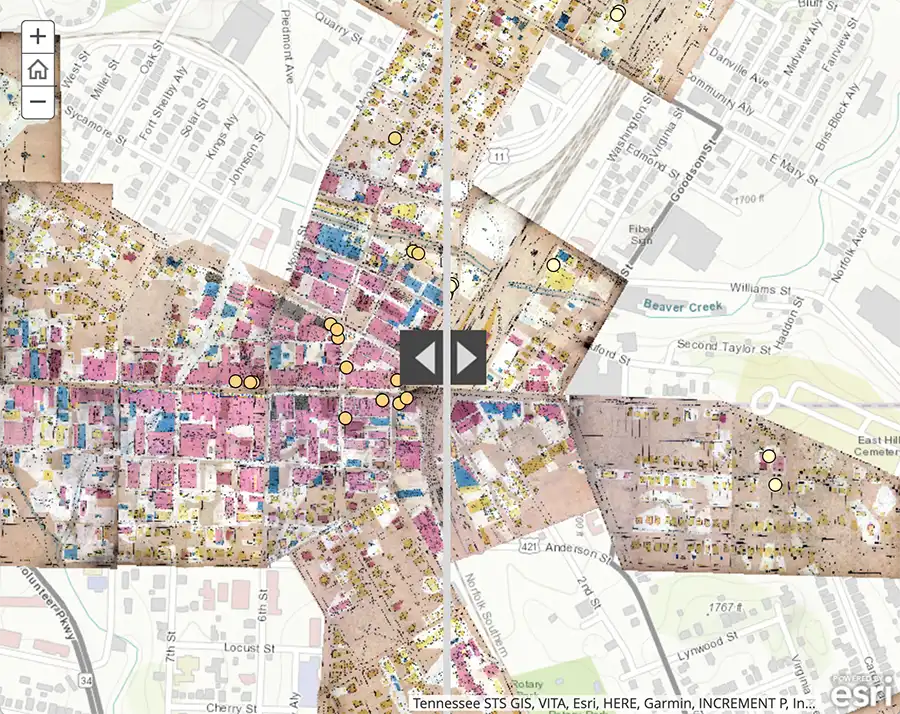
Black owned businesses in the Knoxville area from 1896-1936

February 23, 2021

Black owned businesses in the Knoxville area from 1896-1936

Devyn Kelly’s Storymap

Alumnus from UTK’s Geography Department Devyn Kelly recently completed a time lapse story map depicting the differing rates and dispersal of Black owned businesses in the Bristol, VA area from 1896-1936. This work was done for the Black in Appalachia Project to depict the historic and vibrant community of Black business in Bristol.

Her work is viewable here: https://tga.maps.arcgis.com/apps/StorytellingSwipe/index.html?appid=52e5c1e73b3c45c0ae712ec5d1fdc0bf

This map from the Black in Appalachia website, viewable here: https://t.co/XpiF7FpeXD?amp=1

Filed Under: Alumni News, Department News, Human Geography

Derek Alderman

Alderman Receives 2020 Lorayne W. Lester Award

February 4, 2021

Alderman Receives 2020 Lorayne W. Lester Award

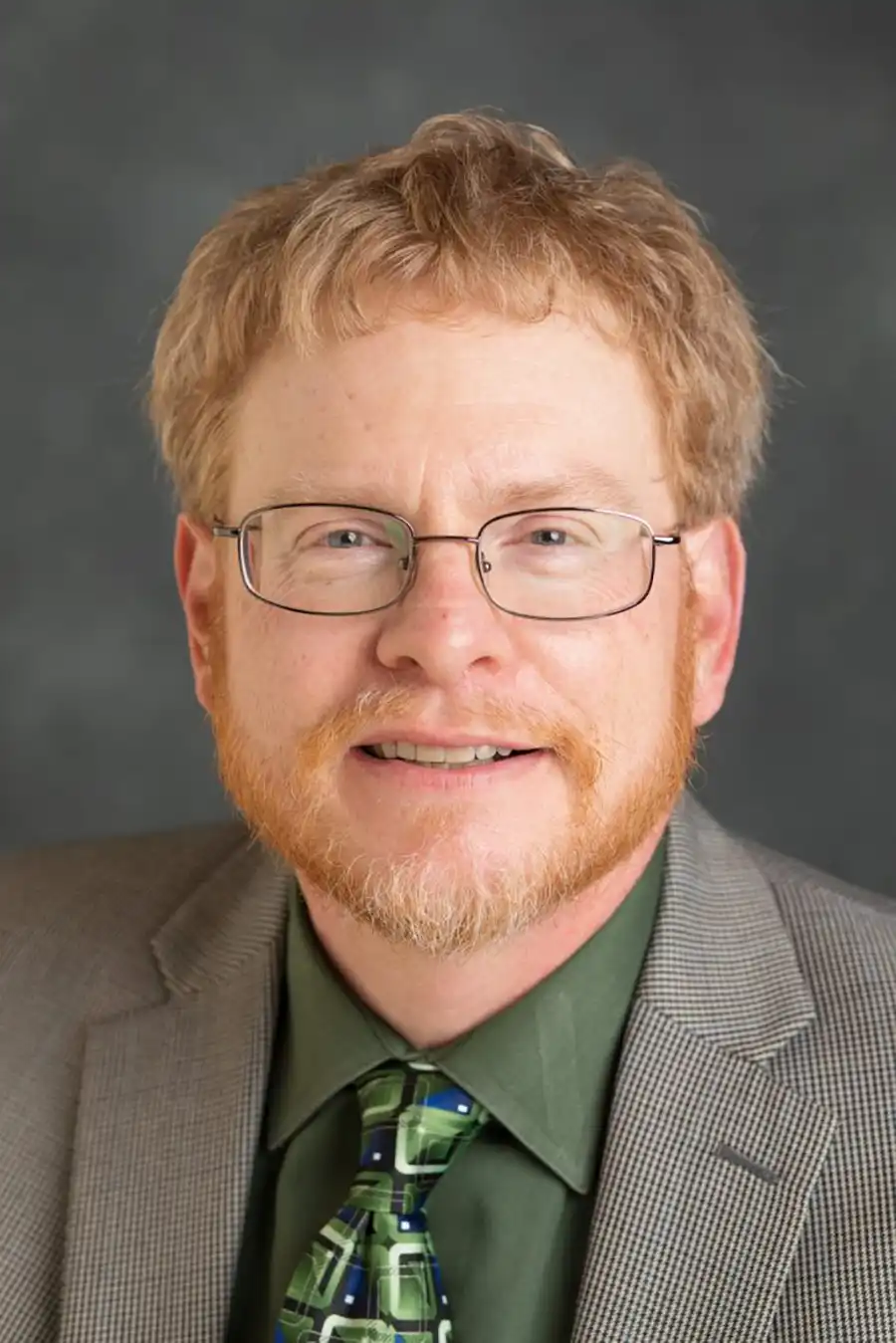
Derek Alderman

Each year, Dean Theresa Lee and members of her cabinet, with help from department heads, recognize faculty in the College of Arts and Sciences for their excellence in teaching, research and creative activity, and lifetime achievements. 

Due to the ongoing pandemic, however, we were unable to host the annual awards banquet in-person. Each faculty member received a plaque and congratulations from the dean. We posted a video to the college YouTube channel here, which features each faculty award winner. 

Derek Alderman, professor and interim head of the Department of Geography, received the Lorayne W. Lester Award, which recognizes a faculty member or exempt staff member who has demonstrated outstanding service through research, outreach, and/or administrative, teaching, or advising services to the college, the state, our local community, or beyond. 

Alderman joined the geography department in 2012 as head and worked hard to advertise and modernize the curriculum for undergraduates, which allowed the department to increase in size dramatically. During his five years as head, he also worked successfully to diversify the faculty and student population. During these years he was also elected president of the American Association of Geographers, after successfully serving as a chair of the association’s publications committee, the regional southeast councilor, and president of the southeast region. 

Alderman’s research brings him many opportunities to inform the public about issues related to American Civil Rights movement and southern culture more broadly. Much of his work focuses on the histories, memory-work, commemorative activism, and place-making efforts of African Americans as they assert and claim civil rights, their right to belong with public spaces, and the power to remember the past and shape the American landscape on their own terms. In particular, his interests focus on critical place name studies and using cultural struggles over the naming and renaming of streets, schools, parks, and other public spaces as important lens for understanding the unresolved place of race, memory, and identity in America. 

“I am grateful and humbled to receive the Lorayne Lester award from our college, which is filled with many inspiring servant-leaders,” Alderman said. “Since coming to UT in 2012, I have been fortunate to have the opportunity to work with others to grow and maintain departmental health, advocate for national professional organizations, and engage in public outreach and partnership building. Service, for me, is about being responsive to the needs and well-being of other people—to think and act beyond oneself. More than simply a category of annual evaluation, service is the lifeblood of the university and key to the ethics of care we owe to ourselves and wider communities.”

He is a devoted scholar-teacher who enjoys working and publishing with students, both at the undergraduate and graduate levels. He is also committed to conducting critical public scholarship that engages, informs, and helps the news media, government officials, community activists and organizations, and the broader citizenry. Most recently, Alderman has been involved in three major research efforts funded by NSF that involved researchers from universities across the country collecting and analyzing data related to the struggle for freedom from several different perspectives. He continues to serve beyond expectations by agreeing to step back into the role of interim head for geography this year when there was a last minute change within the unit leadership.

Filed Under: Department News, Human Geography

David Leventhal

Former Geography Student Thrives As Educator With Help from Student Emergency Fund

January 8, 2021

Former Geography Student Thrives As Educator With Help from Student Emergency Fund

Source: https://news.utk.edu/2020/12/14/with-help-from-student-emergency-fund-graduate-thrives-as-educator

David Leventhal

For David Leventhal, the coronavirus pandemic hit during an already challenging time. A nontraditional student, Leventhal returned to the University of Tennessee, Knoxville, to pursue a master’s degree in secondary education and teaching during midlife with a young child to support and a mortgage to pay.

Completing his master’s degree meant spending an entire year as an unpaid intern teaching at Gresham Middle School and Maryville High School. He applied for mortgage forbearance during that time, expecting to graduate with an offer of employment. However, the educational sector was completely upended when COVID-19 hit, and Leventhal’s prospects disappeared. 

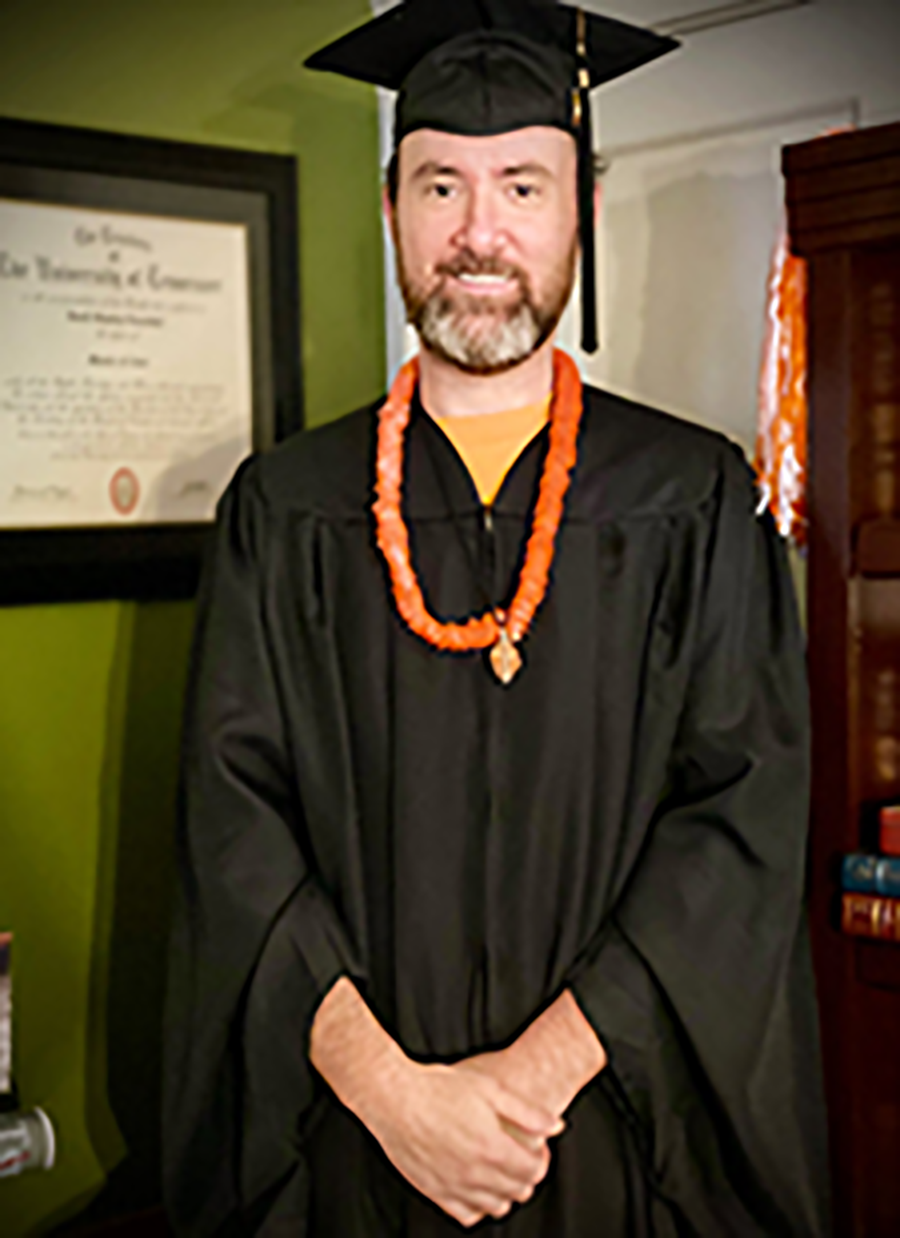
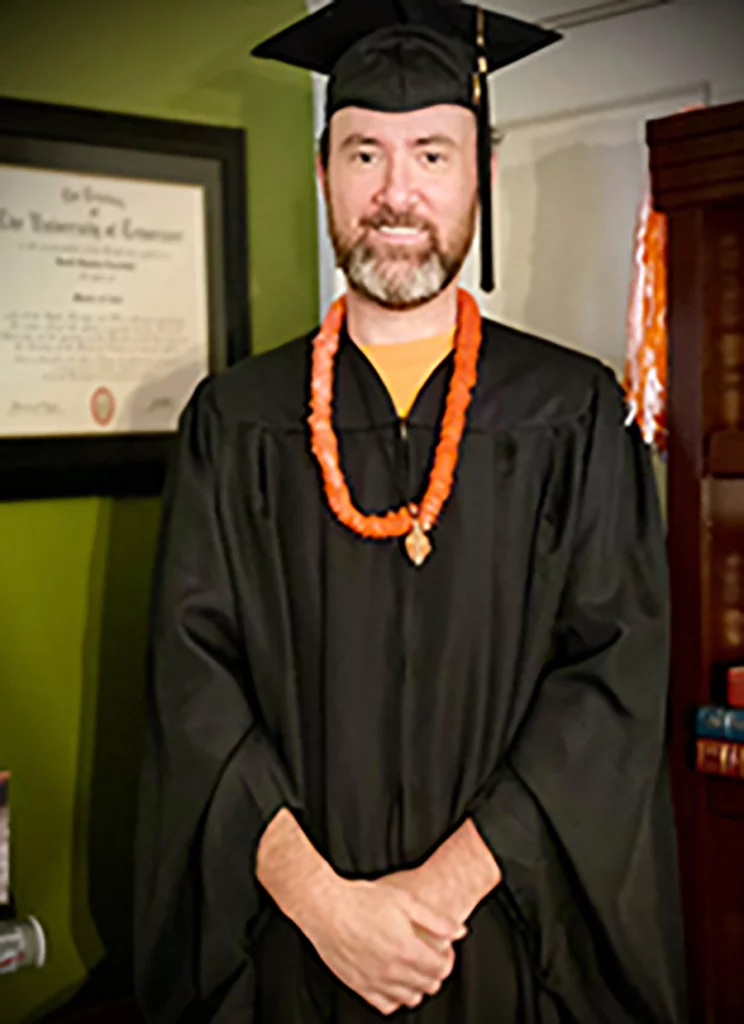
David Leventhal in graduation regalia stands next to his framed Master of Secondary Education degree.

At that point, UT’s Student Emergency Fund and Center for Career Development and Academic Exploration helped him navigate the situation to reach a positive outcome. He has since graduated, found full-time employment, and caught up with his mortgage.

“I really can’t underestimate how helpful and timely the emergency funding was, as well as the career development center,” Leventhal said. “The opportunities that I got were amazing. As disappointing and troubling as 2020 has been, it never ceases to amaze me how something good will happen that just keeps me going.”

Today Leventhal is a full-time social studies teacher with Tennessee Connections Academy, an entirely online public school available to students in Tennessee. His pay and benefits are on par with what he would earn in a brick-and-mortar school, and he’s able to teach from Knoxville. That is crucial for Leventhal because his daughter and her mother live locally.

Leventhal’s path to his current role has taken a number of turns. Originally from Atlanta, he completed his undergraduate degree in philosophy and religious studies at Appalachian State University in 2001. He came to UT and completed a master’s degree in history in 2007. After graduation, he operated a restaurant marketing and delivery business for five years before moving into the information technology sector. He’s also been a banjo and ukulele instructor and taught college-level history.

Now, as a high school teacher, Leventhal wants to bring all of those skills to bear in his social studies instruction. When he was a history student he spent time learning geographic information systems (GIS) because, he said, “as a history teacher, you can’t ignore geography. Everything happens at a time and place.”

GIS can be extremely versatile and allow for data to be overlayed onto maps. One project Leventhal worked on at UT involved correlating a dataset of blighted potato harvests and grain exports during the Irish Potato Famine with statistics on emigration to the United States.

“It was very clear the hardest-hit counties were in the western part of Ireland, and that’s where people emigrated from,” Leventhal said. “When you factor in the folk music and stringed instruments, a picture starts to emerge that connects to our life today.”

Leventhal would like to start a geography club at his school and potentially a GIS club. He wants the subject matter to be relevant to his students. With a bright future as an educator ahead of him, Leventhal reflects positively on the good fortune he has enjoyed during an extremely complicated time.

“My new work with a K–12 virtual public education academy has shown me how to grow as an educator and build my resume while also earning the same compensation as my brick-and-mortar colleagues,” Leventhal said. “I am forever indebted to the University of Tennessee, in more ways than I could ever quantify—and indeed it’s great to be a Tennessee Vol!”

CONTACT:

Gerhard Schneibel (865-974-9299, gschneib@utk.edu)

Filed Under: Alumni News, Department News, Human Geography

  • « Previous Page
  • 1
  • 2
  • 3
  • 4
  • 5
  • Next Page »

Recent Posts

  • Seth Kannarr in ‘The Conversation:’ Trump administration replaces America 250 quarters honoring abolition and women’s suffrage with Mayflower and Gettysburg designs
  • Seth Kannarr in ‘The Conversation:’ What does it mean to be a new national park? Ocmulgee Mounds in Georgia may soon find out
  • Scholar Spotlight: Anna Marshall
  • UT Geography Faculty and Student Receive National Recognition
  • Jack Swab, Derek Alderman in ‘The Conversation’: World maps get Africa’s size wrong: cartographers explain why fixing it matters

Recent Comments

No comments to show.
an illustration of geographers engaged in research surrounding a globe

Geographers Engage With The World

Request More Information

Support The Department

Department of Geography and Sustainability

College of Arts and Sciences

Burchfiel Geography Building
1000 Phillip Fulmer Way
Room 304
Knoxville, TN 37996-0925
865-974-2418
utkgeog@utk.edu


Facebook Icon    X Icon    Instagram Icon    YouTube Icon

The University of Tennessee, Knoxville
Knoxville, Tennessee 37996
865-974-1000

The flagship campus of the University of Tennessee System and partner in the Tennessee Transfer Pathway.

ADA Privacy Safety Title IX