• Request Info
  • Visit
  • Apply
  • Give
  • Request More Info
  • Visit
  • Apply
  • Give

Search

  • A-Z Index
  • Map

Geography and Sustainability

  • About
    • Facilities
    • Alumni
    • Research & Community Partners
    • Geographic Links
  • Areas of Study
    • Physical Geography
    • GIST
    • Human Geography
    • Sustainability
  • People
    • Faculty
    • Staff
    • Graduate Students
    • Adjunct & Affliated Faculty
    • Alumni
    • Emeritus
  • Undergraduate
    • Where Can a Geography Degree Take You?
    • Majors
    • Minors
    • Certificates
    • Advising
    • Forms
    • Apply
  • Graduate
    • MS Program
    • PhD Program
    • Apply
    • Graduate Handbook
    • Forms
  • Student Engagement
    • Clubs
    • Community Engagement
    • Awards
    • Internship and Employment
    • Study Abroad
  • News & Events
    • Statements
    • Share Your News
    • Newsletters
    • News
    • Events
    • Geography Awareness Week
    • GeoSym
topography background

News

Human Geography

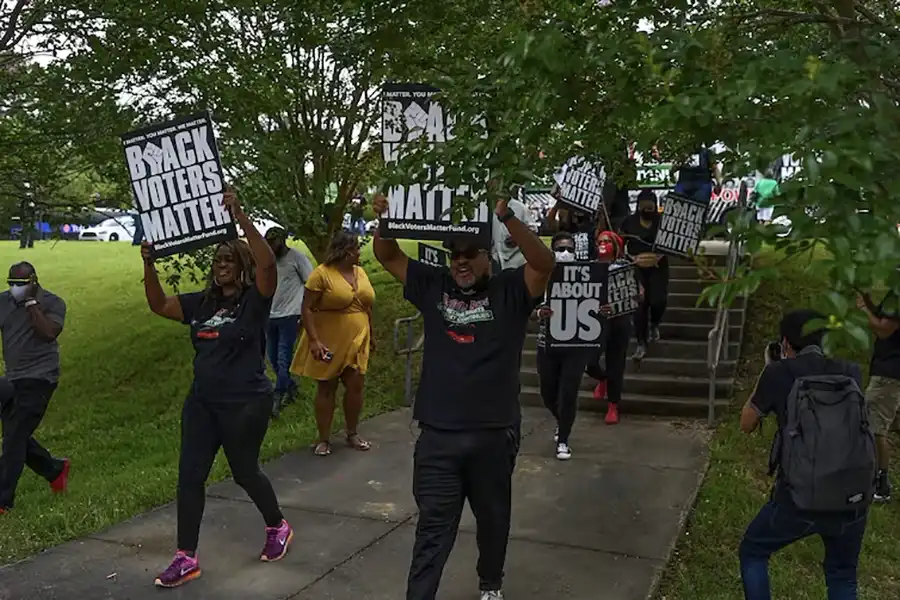
Black Voters Matter demonstrators march during a voting rights rally on June 19, 2021, in Jackson, Miss. Joshua Lott/The Washington Post via Getty Images, Image from article in The Conversation

Alderman Published in The Conversation

November 4, 2022

Alderman Published in The Conversation

How a 2013 US Supreme Court ruling enabled states to enact election laws without federal approval
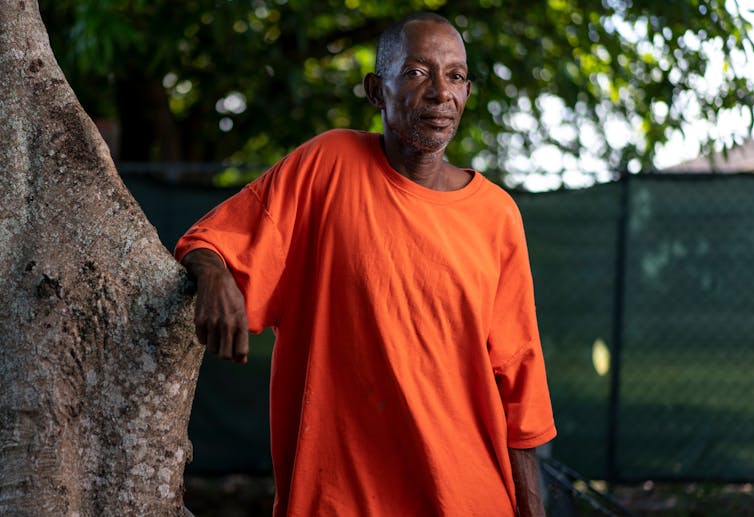
A photo of Terry Hubbard in an orange shirt leaning against a tree
Terry Hubbard, a former felon, voted in the 2020 presidential election and was arrested two years later in Florida on voter fraud charges.
Josh Ritchie for The Washington Post via Getty Images

Joshua F.J. Inwood, Penn State and Derek H. Alderman, University of Tennessee

Since 2019, legislators and election officials in Florida have revised, passed and enforced restrictive voting laws that make it harder for poor people, former felons and people of color – who traditionally favor Democrats in elections – to vote.

At the same time, they appear to have taken exceptional measures that have made it easier for voters in Republican areas of the state to cast their ballots, especially after a natural disaster.

The pattern of favoring GOP voters and discriminating against people of color, especially against Blacks, has been so obvious that, in a brief filed in federal court on Aug. 17, 2022, federal prosecutors argued that Republicans lawmakers targeted Black voters when they enacted the new election law in Florida, a charge denied by lawyers defending the state.

Yet less than a week after the filing, instead of addressing widespread concerns over the restriction of voting rights, Florida Gov. Ron DeSantis held a news conference to show how his state is taking “voter fraud” seriously.

Despite the lack of evidence of widespread voter fraud, DeSantis told the assembled media that the state’s new Office of Election Crimes and Security was in the process of arresting 20 Florida residents for allegedly committing voting fraud.

Based on media reports, the majority of those pursued by authorities were Black voters.

Although a judge dismissed charges filed against one man, we believe these arrests are a bellwether of more efforts Americans will likely see to intimidate voters under the guise of election security.

The question, then, is how are states allowed to enact election laws that appear race neutral – but have a disproportionate impact on voters who have been historically disenfranchised?

Impact of Shelby v. Holder

We are scholars of the American civil rights movement and the role of geography and voter intimidation in the long struggle for Black voting rights.

The actions in Florida are part of a national trend that saw dozens of states across the country overhaul their election laws after former President Donald Trump’s persistent and false claims of fraud in the 2020 presidential election.
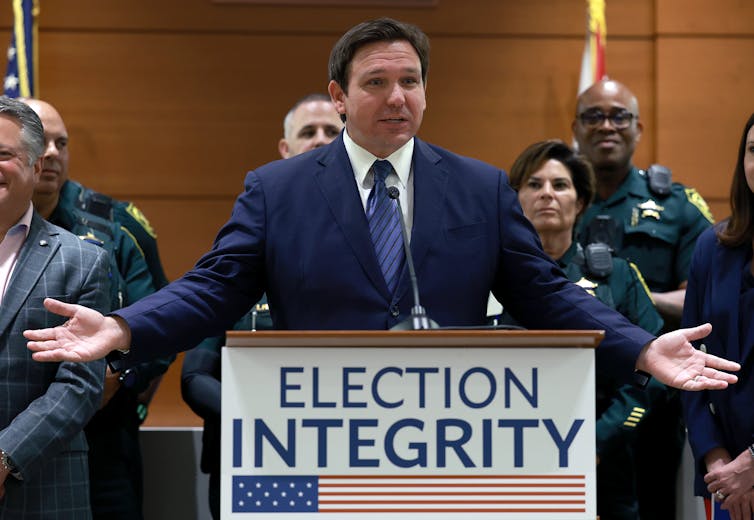
A white man dressed in a business suit stands with outstretched arms behind a lectern that has a sign bearing the words Election Integrity.
Florida Gov. Ron DeSantis announces on Oct. 18, 2022, that the state’s new Office of Election Crimes and Security is in the process of arresting 20 individuals for voter fraud.
Joe Raedle/Getty Images

The rash of new state election laws includes everything from closing polling places to restricting the time and place of early voting. They also include partial bans on providing water and food to people standing in line to vote.

Not all of these laws included restrictions, and some were established to avoid health risks during the COVID pandemic.

These bills were often couched in the language of preventing voter fraud to protect democracy. “Voter confidence in the integrity of our elections is essential to maintaining a democratic form of government,” said Florida’s Republican Senate president, Wilton Simpson.

But voting rights experts argue that instead of prohibiting election fraud, many of the new laws may make it harder for people to vote.

In the past, the 1965 Voting Rights Act included requirements that, in states that historically had discriminated against the right of Black people to vote, such major changes to election law would have sparked a review by the U.S. Department of Justice to determine whether they could take effect.

The loss of that federal oversight was made possible by a 2013 U.S. Supreme Court 5-4 decision in the case of Shelby v. Holder. That decision eliminated the oversight requirements of the 1965 Voting Rights Act.

From the outset of the Voting Rights Act, Alabama, Alaska, Georgia, Louisiana, Mississippi, South Carolina and Virginia were required to have federal oversight in order to prohibit those states’ adopting discriminatory election laws.

In addition, several specific counties in Arizona, Hawaii, Idaho and North Carolina were also found to have discriminated in the past, thus requiring federal oversight.

New state election laws

These states, long under scrutiny by the federal government for discriminatory voting laws, were some of the first states to enact new and more restrictive voting regulations and rules after the 2013 Supreme Court ruling.

Yet these states were not the only ones to consider changing or enacting new election laws since the 2020 presidential election. In 2022 the effort to restrict the right to vote has accelerated.

Thirty-four bills currently are moving through 11 state legislatures to restrict access to the vote. In all, 39 states have considered over 390 restrictive bills, and these efforts affect minority voters most specifically.

Though the impact on voter turnout is an open question among election experts, one thing is clear – the number of polling places and voting drop boxes in communities of color has diminished since before the COVID-19 pandemic.

While inconsistent data reporting makes it difficult to determine the exact number and location of closed polling places, recent statistics suggest that since the 2013 ruling, at least 750 voting locations in Texas, 320 in Arizona, 240 in Georgia, 126 in Louisiana, 96 in Mississippi and 72 in Alabama have closed.

Modern-day poll tax

In all, over 1,600 polling places have closed across the U.S. since the Holder decision in 2013.

Recently, civil rights organizations, including the NAACP Legal Defense Fund, have pressed Mississippi for information on poll closures in the state to determine if new election laws there are having a detrimental impact on Black residents’ ability to vote.

According to the Mississippi Free Press, the state “does not provide an up-to-date, comprehensive list or database of voting precincts to the public,” as required by law.

These closings, often done with little notice or public accountability, have occurred across communities of varying racial and demographic characteristics.

What unites these places across the country are the increased burdens and costs they impose on voters of color, older voters, rural voters, voters with disabilities and poor working people in general.

In our view, the poll closings since the Holder decision have created significant financial costs for those least able to bear them. We see the long lines as more than an inconvenience – they are effectively a modern-day poll tax.
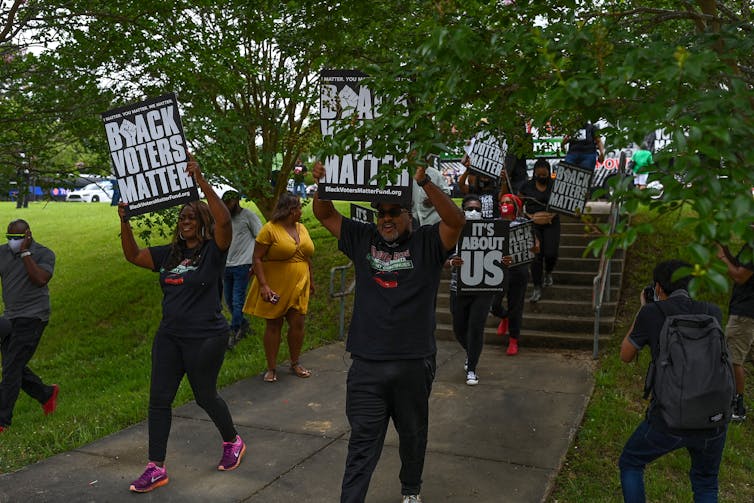
Scores of black demonstrators holding posters march to support black voting rights.
Black Voters Matter demonstrators march during a voting rights rally on June 19, 2021, in Jackson, Miss.
Joshua Lott/The Washington Post via Getty Images

The poll tax was an amount of money each voter had to pay before being allowed to vote. After the Civil War, many Southern and Western states used the poll tax and other Jim Crow measures to keep poor and minority voters from being able to cast ballots.

The frequently exorbitant taxes were outlawed in 1964 by the the 24th Amendment to the U.S. Constitution.

Our research shows that democracy depends upon communities’ having equitable social and geographic access to voting places.

The new Florida election law was challenged in March 2022 by voting rights advocates, the League of Women Voters of Florida and the Florida NAACP. Though that case is under appeal – and restrictions were allowed to remain in place during the midterm election – Chief U.S. District Judge Mark Walker found in his lower court ruling that the Florida law placed restrictions on voters that were unconstitutional and discriminated against minority citizens.

“At some point, when the Florida Legislature passes law after law disproportionately burdening Black voters, this court can no longer accept that the effect is incidental,” Walker wrote.The Conversation

Joshua F.J. Inwood, Professor of Geography and Senior Research Associate in the Rock Ethics Institute, Penn State and Derek H. Alderman, Professor of Geography, University of Tennessee

This article is republished from The Conversation under a Creative Commons license. Read the original article.
Filed Under: Department News, Human Geography

Emily Frazier

Geography alumna Emily Frazier published an op-ed in Washington Post

October 12, 2022

Geography alumna Emily Frazier published an op-ed in Washington Post

Headshot photo of Emily Frazier

Our Geography alumna Dr. Emily Frazier just published an op-ed in the Washington Post titled “Geopolitics, not humanitarianism, has long guided U.S. refugee policy“. 

Emily graduated from our PhD program in 2019, and she is currently an Assistant Professor of human geography at Missouri State University, and her research focuses on refugee resettlement in the U.S.

Congratulations, Emily! 

Filed Under: Alumni News, Department News, Human Geography

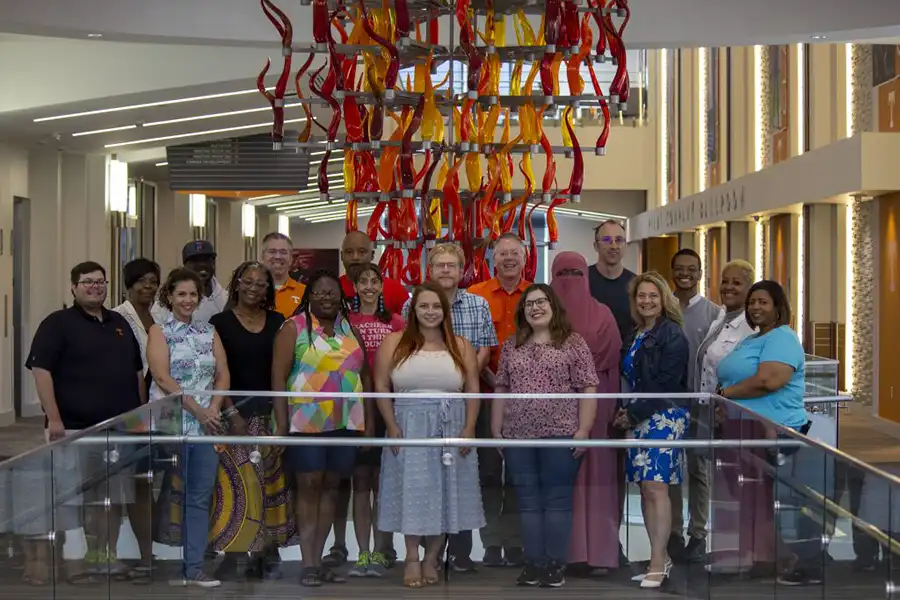
Group of students in the UT Student Union

Geographic Mobility as a Civil Right

September 23, 2022

Geographic Mobility as a Civil Right

Summer teaching institute explores geographic mobility as it relates to the African American freedom struggle

Geographic Mobility Cohort

In July of 2022, the University of Tennessee, Knoxville, hosted a residential summer institute for K-12 educators from across the US, funded by a National Endowment for the Humanities grant (NEH). Participants explored the history of the Civil Rights movement through geographic mobility. The institute highlighted the central role of migration, transportation, and travel and tourism in structural racism and the fight for African American freedom and self-determination.

Participants attended lectures and lab exercises; participated in discussions; and learned methodologies and classroom activities from curriculum and content specialists. They also took field trips around Knoxville, Nashville, and Memphis as part of the institute’s commitment to place-based education.

Derek Alderman
Dr. Alderman

“Through the institute, we offered a model of critical thought, instruction, and pedagogical application that supports ongoing calls for greater numbers of social studies educators to address power and inequity,” said Derek Alderman, professor of geography.

Alderman and colleague Joshua Kenna, associate professor of social science education in the UT College of Education, Health, and Human Sciences, received nearly $200,000 in funding to host the institute from the National Endowment for the Humanities “A More Perfect Union” initiative, which aims to promote a deeper understanding of American history and culture.

Headshot photo of Joshua Kenna
Joshua Kenna

“In addition to having a well-rounded curriculum that utilizes several experts from the field and provides experiential learning opportunities, we’re also proud of our strong emphasis on building and fostering relationships with teachers,” Kenna said. “The goal is not achieved when they acquire the content, it is only achieved when we help them grapple with and overcome pedagogical and logistical hurdles so that they can teach this content in their classrooms.”

Workshops featured guest lectures and hands-on lessons from experts on geographic mobility, race and racism, oral history, digital mapping and the humanities, and pedagogy. The institute culminated with participating teachers developing and presenting curriculum projects and ideas for teaching about the role of migration, transportation, travel and tourism within the Black civil rights experience.

“Our hosting of this summer institute in Knoxville received high marks from participating teachers and NEH program directors. It further cements the University of Tennessee’s reputation as a national leader in teacher training and creating important synergies between the teaching of history, geography, and social justice,” Alderman said. “The university welcomed a brilliant group of K-12 teachers, many of whom are educators of color. They significantly advanced discussions of diversity and inclusion on our campus and taught many of the institute’s staff important lessons about the struggles currently facing the nation’s teachers.”  

Read more about the UT initiative, Geographic Mobility in the African American Freedom Struggle, and the NEH grant award that supported this important work in the Department of Geography and Sustainability and the Department of Theory and Practice in Teacher Education at UT.

Filed Under: Department News, Featured News, Human Geography

Headshot photo

Geography Student Morgan Steckler’s summer internship with Maxar

August 5, 2022

Geography Student Morgan Steckler’s summer internship with Maxar

Morgan Steckler

This summer, our Geography MS Student Morgan Steckler is working with Maxar as an intern. Maxar is a space technology company headquartered in Westminster, Colorado, United States, specializing in manufacturing communication, Earth observation, radar, and on-orbit servicing satellites, satellite products, and related services. 

Maxar Logo

Here is what Morgan shared with us:

“This summer, I worked remotely for Maxar Technologies as a data science intern on the Kestrel team. I analyzed maritime vessel loitering behaviors through independent research and scripted processing of remotely sensed data. This internship greatly improved my understanding and appreciation of the private space and intelligence industry, efficient and effective teamwork, and the colorful role of a data scientist.” 

Reference: ESRI Living Atlas app for US Vessel Traffic.

Filed Under: Department News, Featured News, GIST, Human Geography, Physical Geography, Sustainability

Best and Worst States for Summer Road Trips, Adam McCann, screen shot

Dr. Derek Alderman featured on WalletHub

June 22, 2022

Dr. Derek Alderman featured on WalletHub

Derek Alderman
Dr. Alderman

Dr. Derek Alderman was featured in WalletHub’s recent study – 2022’s Best & Worst States for Summer Road Trips.

Here are Dr. Alderman’s advice on summer road trips:

I would encourage and expect to see many American travelers taking summer road trips to historical sites and park areas that allow the public to explore the history of the civil rights struggles of the United States.

As more states pass laws that seriously limit discussions of racism and inequality in America’s schools, it will be important for families to identify and explore road trips that help children and parents explore these lessons and think about their relevance for understanding the country today.

Destinations such as Equal Justice Institute’s National Memorial for Peace and Justice, the nation’s first memorial to the victims of racial terror lynching, are one of these important must-sees.

Filed Under: Department News, Human Geography

Geography Awards Ceremony group photo

Annual Awards Ceremony 2022

May 6, 2022

Annual Awards Ceremony 2022

Welcome slides

Award slides

Awards Ceremony Photos

Filed Under: Department News, GIST, Human Geography, Physical Geography, Sustainability

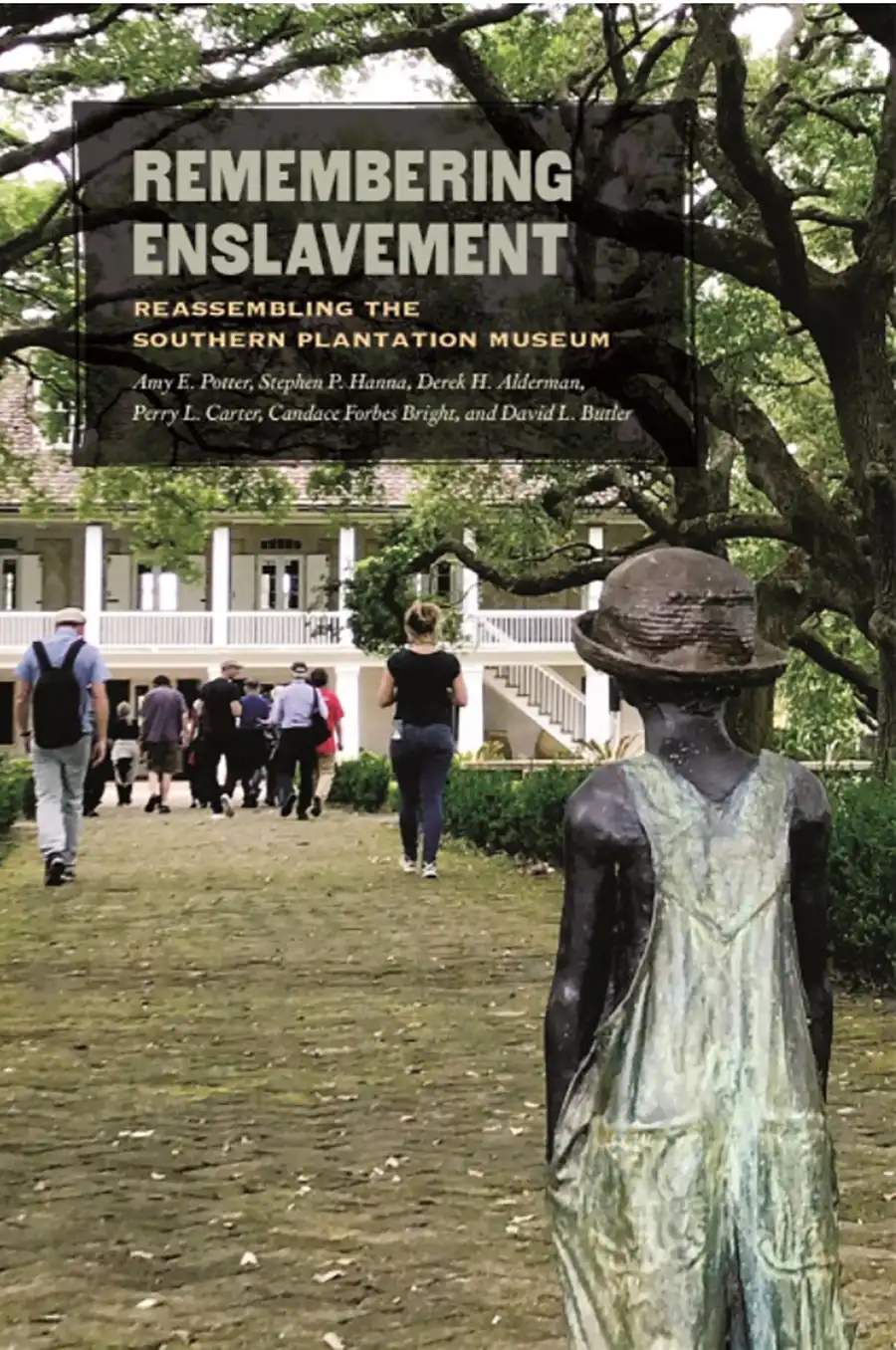
Remembering Enslavement book jacket

Dr. Derek Alderman published a new book

April 29, 2022

Dr. Derek Alderman published a new book

Remembering Enslavement book jacket
Dr. Alderman

Congratulations to Dr. Derek Alderman for publishing a new book entitled “Remembering Enslavement: Reassembling the Southern Plantation Museum“, which was published on March 15, 2022. The book was co-authored by Amy E. Potter, Stephen P. Hanna, Perry L. Carter, Candace Forbes Bright, and David L. Butler. The team also published an article in Washington Post entitled “Changes at Montpelier work against repairing the wounds of slavery“.

Filed Under: Department News, Human Geography

Remembering Enslavement book jacket

Alderman Co-Authors Book on Plantation Museums

April 20, 2022

Alderman Co-Authors Book on Plantation Museums

Remembering Enslavement book jacket

University of Tennessee Geography Professor Derek Alderman recently co-authored Remembering Enslavement: Reassembling the Southern Plantation Museum, published by the University of Georgia Press.

Remembering Enslavement is one of the most comprehensive analyses of plantation museums. It draws from recent theories in museum and heritage studies and thousands of interviews and surveys with tour guides, visitors, site managers, and owners of the plantation museums. The book demonstrates a new, award-winning method for mapping narratives told on guided tours.  

There is also a focus on how plantation museums should challenge romanticized myths about the Old South that have long ignored the realities of the Black experience. Authors of the book visited and gathered data at 18 plantation museum sites across Louisiana, South Carolina, and Virginia. While finding that some sites are reforming their treatment of slavery, they assert that plantation museums overall still have much work to do to center struggles and contributions of formerly enslaved communities.  

“The book’s great value, in my view, is how it ends by offering practical guidance to plantation museum management on how their heritage tourism sites can do greater justice to Black lives and histories,” Alderman said. 

The book comes from a four-year National Science Foundation grant that began as a comprehensive research agenda focusing on socially responsible approaches to tourism development. Alderman received additional funding from UT that allowed him to involve geography undergraduate and graduate students in fieldwork at museums. 

The book and grant were carried out with the support of Tourism RESET, a multi-university research and outreach initiative founded by Alderman and co-directed by UT Assistant Professor Stephanie Benjamin and Alana Dillette of San Diego State University. The organization takes aim at racial inequalities in the tourism industry and focuses on supporting the needs and activism of marginalized travelers.

Moving forward, Alderman is focusing on the politics of historical narration at presidential plantation museums. His research team recently completed data collection at lands previously owned by George Washinton, Thomas Jefferson, James Madison, and James Monroe. 

“While some of the presidential museums are trying to do a better job of discussing slavery, there are still clearly limits at which these sites are willing to talk about the brutal realities of slavery and fully recognize the histories of enslaved Black Americans—especially if it detracts from the heroic status and reputation of the Founding Fathers,” Alderman said.

–Story by Sarah Berry

Filed Under: Department News, Human Geography

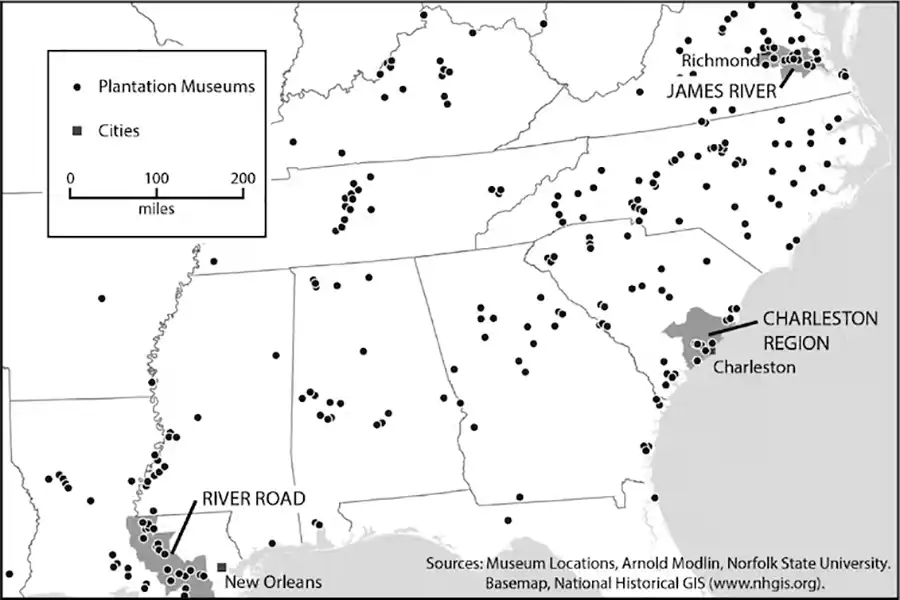
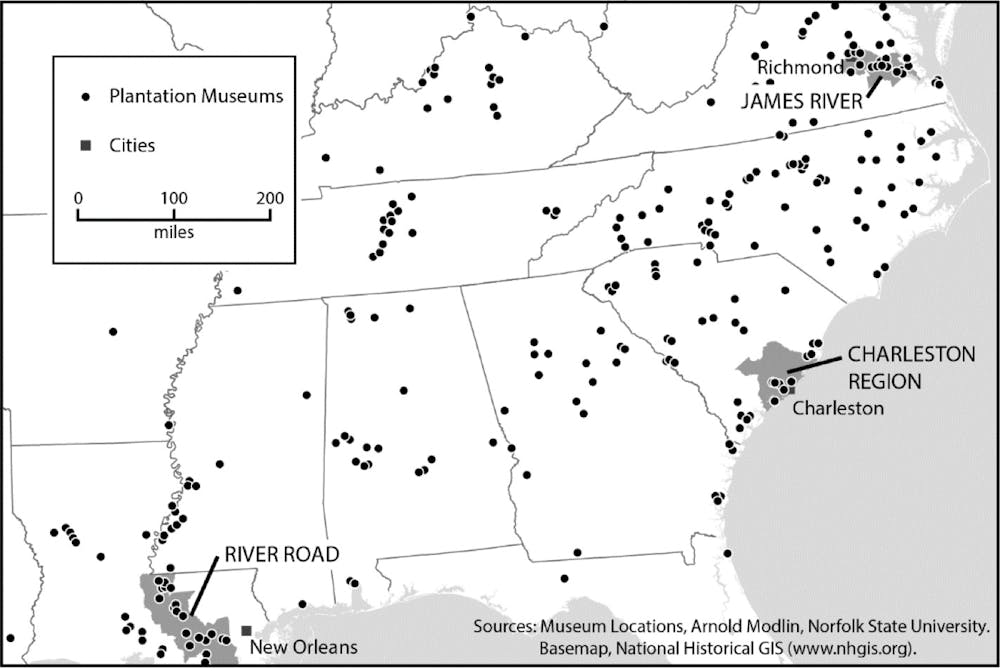
A map that represents the number of slave plantation museums in the American south, image from article in The Conversation

Plantations could be used to teach about US slavery if stories are told truthfully

April 18, 2022

Plantations could be used to teach about US slavery if stories are told truthfully

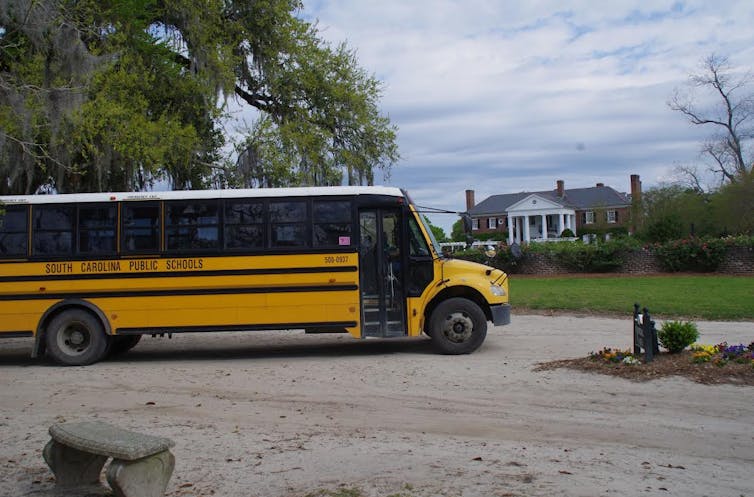
A yellow school bus with South Carolina Public Schools printed on the side, a large house is in the background
Hundreds of plantation museums dot the South. Amy Potter

Amy Potter, Georgia Southern University and Derek H. Alderman, University of Tennessee

State legislatures across the United States are cracking down on discussions of race and racism in the classroom. School boards are attempting to ban books that deal with difficult histories. Lawmakers are targeting initiatives that promote diversity, equity and inclusion in higher education.

Such efforts raise questions about whether students in the U.S. will ever be able to engage in free and meaningful discussions about the history of slavery in America and the effect it had on the nation.

As cultural geographers, we see a potential venue for these kinds of discussions that we believe to be an overlooked and poorly used resource: plantation museums.

If slavery is, as historian Ira Berlin argues, “ground zero for race relations,” then the hundreds of plantation museums that dot the southeastern U.S. landscape seem like natural places to confront the difficult history of America’s slave-owning past.

Exploring that possibility is one of the reasons why – along with fellow tourism scholars Stephen Hanna, Perry Carter, Candace Bright and David Butler – we received a federal grant to research plantation museums across the U.S. South.

We think these plantation museums could be important sites for an educational reckoning with this difficult aspect of America’s past. But that’s only if the people who run these museums are committed to telling the truth about what took place, rather than perpetuating myths about Black life in America under white domination and oppression. This is particularly important as policymakers seek to curtail discussions about racism – or even themes that make people feel “discomfort” – in America’s K-12 schools and colleges and universities.

Usages of these sites have traditionally romanticized life before the Civil War and ignored or trivialized the horrors of slavery. They have also downplayed the resistance and resilience of enslaved communities, thus preventing the nation from getting a fuller and more accurate picture of American slavery.

Reforms needed

In order to make better use of plantation museums as places to learn about racism and slavery, the museums must be reformed in a major way and do more than just entertain tourists and sell a heritage experience. Rather, this reform demands a reworking of almost every facet of the museum – from misguided tours that gloss over the harsh living conditions of the enslaved to artifacts and marketing materials that emphasize the opulent and picturesque mansions that belie the horrors of what took place on the surrounding grounds. In our research, we discovered plantation museums where 50% of the tours never mentioned slavery. Our work provides practical guidance to the changes that need to happen.

A map that represents the number of slave plantation museums in the American south.
Many former plantations are now museums. Stephen Hanna, CC BY

Problematic places of learning

Within the United States, there are at least 375 plantations open for public tours scattered across 19 states. Based on nearly 2,000 surveys our research team conducted, visitors have indicated that they go to plantations to “learn about history.” The general public considers historical sites, such as plantation museums, to be trusted sources for historical information. Therefore, they deserve to be held accountable for the educational experience they provide.

School field trips are an important revenue source for these often cash-strapped sites.

At Shirley Plantation in Virginia, field trips accounted for over 15% of total visitors. At Meadow Farm, near Richmond, Virginia, 40% of the site’s visitors are school children. At Boone Hall in South Carolina, 14,000 school children visit the site annually.

Whitewashing of history

At one Virginia plantation museum, we observed school children go on scavenger hunts where they take on the roles of white slave owners. In one case, the children deliver a message between the white slave owner’s son – a Confederate soldier – and his sick mother while their plantation was occupied by Union troops. This, we believe, leads the children to identify and empathize with the white slave-owning family as opposed to the individuals they enslaved.

Toward reparative education

Our work calls for plantation museums to engage in a more reparative form of education. This education would come to terms with the injustices of the past and correct the way enslavement is actively misremembered in the present, which in turn harms Black well-being and sense of belonging.

Repairing these historical fallacies is not just about getting the facts correct about the enslaved and the enslavers. It also requires the public to learn certain emotional and social truths about how slavery is a source of pain and tension in America. Lessons should show how this tension continues to impact race relations. Often overlooked is how enslaved labor was used to construct buildings, roads, ports and rail lines we use in America.

Our research found that many plantation museums were reluctant to highlight Black lives and histories. But there is promising evidence of change at sites like McLeod Plantation on James Island in Charleston, South Carolina, which opened in 2015, less than a year after the more well-known Whitney Plantation in Louisiana.

We see both museums – Whitney and McLeod – as exceptional in plantation tourism. Combined, our research found these two sites attract a more racially diverse visitorship than many other plantations because of the inclusive stories being told. Our surveys with visitors suggest public interest in the topic of slavery increased after taking guided tours that focused on the experiences of enslaved communities. In our view, this is a needed counterpoint to media reports of some visitors pushing back against hearing these sober discussions. For instance, tour guides at McLeod reported white visitors yelling at them, claiming the tour attacked their ancestors.

Both of these plantations represent a new way of educating the public about the realities of slavery. Here are three things that stood out during our assessment of the Whitney and McLeod plantations.

Large marble tablets are set along a green pasture.
At the Whitney Plantation in Louisiana, marble walls memorialize those who were enslaved. Amy Potter, CC BY

1. They incorporate slavery and the lives of the enslaved throughout the tour

We think it’s important to feature slavery and the lives of the enslaved during all aspects of the tour and not keep it separate in a special exhibit.

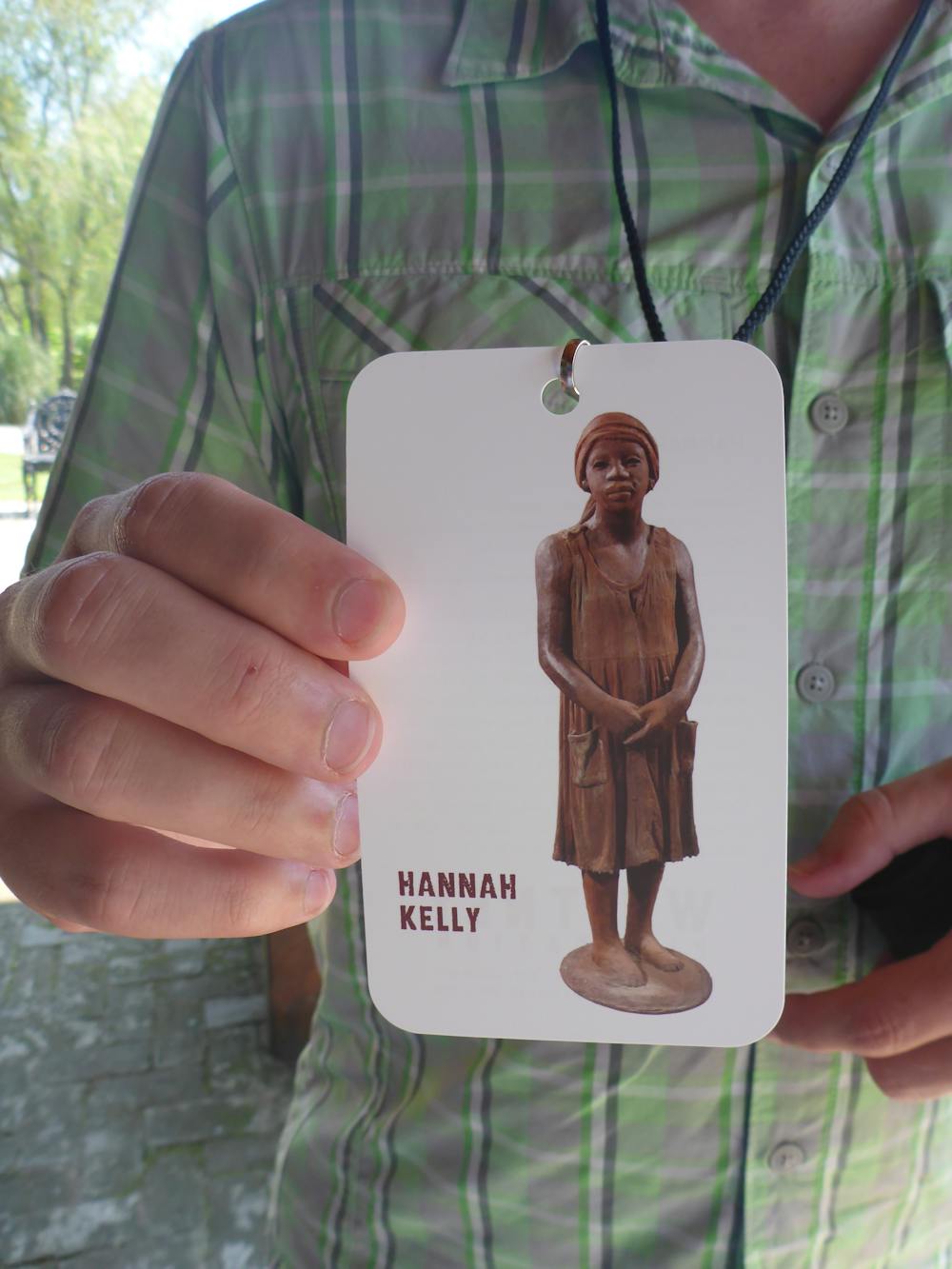
Visitors should be given an opportunity to make thoughtful connections to those who were once enslaved by learning names and details about their lives. At Whitney, for example, visitors are encouraged to make emotional connections. One way they do this is by receiving a lanyard at the start of the tour that features the words and image of a formerly enslaved child.

2. They provide visitors a space to contemplate

We know the plantation can be an especially fraught and emotional experience, particularly for Black visitors. During our fieldwork, Black visitors would often describe the land as sacred and a powerful place to connect to the ancestors. Some of these plantations have even hosted Black family reunions. Whitney Plantation provides opportunities for visitor reflection and contemplation throughout the tour, such as benches near a wall that memorializes and honors all of the people who were enslaved there.

3. Tour guides were well prepared

A man holds up a photo of an enslaved woman named Hannah Kelly
A man visiting the Whitney Plantation in Louisiana holds up a lanyard featuring an image of an enslaved child named Hannah Kelly.
Amy Potter, CC BY

McLeod’s management purposely hired guides who would disrupt romantic notions of the plantation and engage meaningfully with themes of slavery, race and social justice. They also provided ongoing training and support to guides doing the difficult work of challenging or complicating long-held plantation myths.

[Over 150,000 readers rely on The Conversation’s newsletters to understand the world. Sign up today.]

Managers at McLeod acknowledged the stress experienced by their tour guides when they focused on enslavement and its aftermath. They took extra steps to ensure that their guides were supported by initiating a “golden hour.” This was a time for staff to come together and reflect on difficult encounters with the visitors, who sometimes challenged guides’ historical knowledge and fairness. It was also a time for the guides to develop strategies to cope with the emotional toll of the hostility they faced while doing their jobs.The Conversation

Amy Potter, Associate Professor of Geography, Georgia Southern University and Derek H. Alderman, Professor of Geography, University of Tennessee

This article is republished from The Conversation under a Creative Commons license. Read the original article.
Filed Under: Department News, Human Geography

Alum Emily Craig and Intern Olivia Lamm

Congratulations to Olivia Lamm for her Internship with East TN Development District

March 8, 2022

Congratulations to Olivia Lamm for her Internship with East TN Development District

Photo of Olivia Lamm
Olivia Lamm

The UTK Geography Department is thankful for our amazing alum at East Tennessee Development District (ETDD) who work with our students as mentors and internship supervisors. Emily Craig, 2019, has this to say about working with Olivia:

Photo of Emily Craig
Emily Craig (’19)

Olivia is one of the best students I’ve had the pleasure of mentoring as an internship supervisor at ETDD. She came onboard to assist in the ongoing update of our county-wide Census Reports following the release of 2020 Decennial Census data mid-last year. With minimal guidance, Olivia led the identification of Census source tables, collection of relevant data from those tables, as well as data reformatting for all 15 county reports. With 18 tables in each report, she prepared a total of 270 tables. Olivia proved her technical writing skills in her updates to the written sections of each report as well. This project has required a high level of coordination, organization, and record-keeping on her end, which she continues to execute with great success. Her ability to communicate and meet deadlines during a remote internship has been especially impressive. I look forward to continuing this project with her as the updates progress. Olivia is a great example of the caliber of students I’ve worked with from the University of Tennessee Geography Department. Through my past two years of internship supervision, guest speaking, and career mingles, I’ve met and mentored bright, dedicated individuals who no doubt have promising careers ahead of them. As a UTK Geography alumnus, I’m so thankful to have that connection to my home department along with an employer who encourages it – student mentorship adds value not only to students’ lives as future-professionals, but to my life as a current-professional and to our organization as well. I hope to continue giving back to the department in this way, as it did so much for me during my time there.

Filed Under: Alumni News, Department News, GIST, Human Geography, Internship

  • « Previous Page
  • 1
  • 2
  • 3
  • 4
  • 5
  • Next Page »

Recent Posts

  • Seth Kannarr in ‘The Conversation:’ Trump administration replaces America 250 quarters honoring abolition and women’s suffrage with Mayflower and Gettysburg designs
  • Seth Kannarr in ‘The Conversation:’ What does it mean to be a new national park? Ocmulgee Mounds in Georgia may soon find out
  • Scholar Spotlight: Anna Marshall
  • UT Geography Faculty and Student Receive National Recognition
  • Jack Swab, Derek Alderman in ‘The Conversation’: World maps get Africa’s size wrong: cartographers explain why fixing it matters

Recent Comments

No comments to show.
an illustration of geographers engaged in research surrounding a globe

Geographers Engage With The World

Request More Information

Support The Department

Department of Geography and Sustainability

College of Arts and Sciences

Burchfiel Geography Building
1000 Phillip Fulmer Way
Room 304
Knoxville, TN 37996-0925
865-974-2418
utkgeog@utk.edu


Facebook Icon    X Icon    Instagram Icon    YouTube Icon

The University of Tennessee, Knoxville
Knoxville, Tennessee 37996
865-974-1000

The flagship campus of the University of Tennessee System and partner in the Tennessee Transfer Pathway.

ADA Privacy Safety Title IX